Louhi in the Kalevala and the folk songs
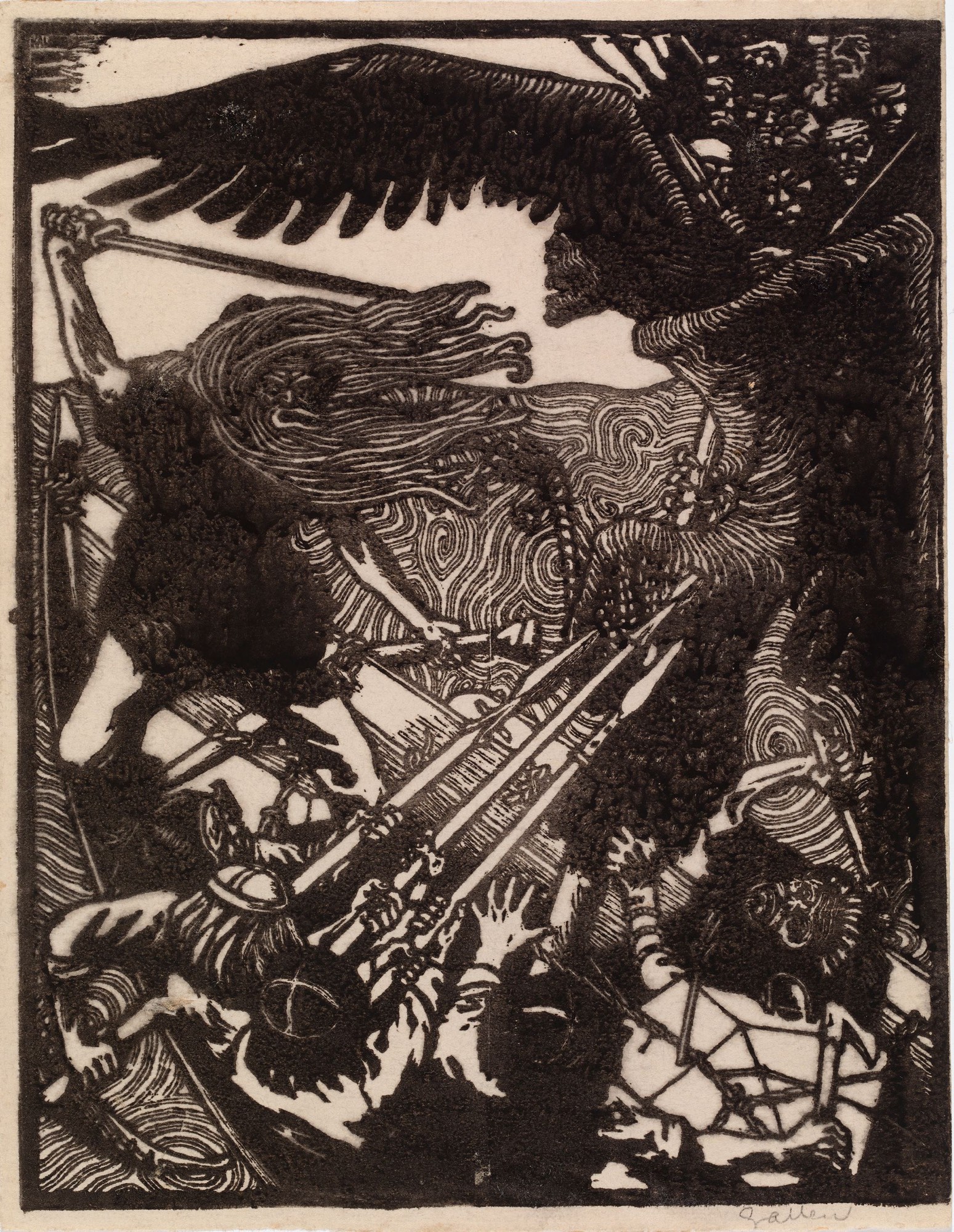
In the Kalevala
The mistress of Pohjola, called Louhi in the verses, takes in Väinämöinen when an eagle brings him to the shore of Pohjola, and promises him her daughter if he forges the Sampo for Pohjola (canto 7). She sets the suitors their tasks and promises her daughter to Ilmarinen (cantos 13 and 19), and after Lemminkäinen kills her husband she raises an army against him (canto 27). When the Sampo is taken, she pursues the raiders in a warship and manages to get it out of their boat into the sea, where it breaks (canto 43). Afterwards she sends diseases and a bear against Kalevala and hides the moon and the sun inside a mountain, letting them go only when she begins to fear for herself (cantos 45–49).
Written for RunoVerse by the AI model Claude Opus 5.5 from Lönnrot's summaries of the cantos.
In the folk songs
355 songs in the archive collections name a mistress of Pohjola, as Pohjolan emäntä, Pohjan akka or in other forms. Few of them also call her Louhi, nearly always followed by Pohjolan emäntä, and those few are mostly charms and hunting songs. Lönnrot's Kalevala uses both names for one figure; whether the songs mean one figure is not decided here. Their records place the songs above all in Viena Karelia, then in North Karelia and Olonets Karelia (Aunus). The song types they are filed under are led by the forging and the theft of the Sampo, the shooting of Väinämöinen, the creation of the world and the wooing contest; charms on the origin of stitches and of diseases also name the mistress of Pohjola.
These lines in Lönnrot's Kalevala
Kalevala, 1849, canto 7, lines 339–344
Folk song: SKVR I1 79 a), Vuokkiniemi, 1833
Lönnrot's Kalevala of 1849 has lines like these in canto 7; the marked words are in both texts, some in another form. This song was written down in 1833, before Lönnrot published the first Kalevala in 1835.
English under the folk-song lines: translated for RunoVerse by the AI model Claude Fable 5.2. English under the Kalevala lines: W. F. Kirby, 1907.
Compare side by side · Open the song in the poem reader · Read canto 7 with Kirby's English
Lines from the folk songs
One line from the earliest record of known year at each of the ten places with the most songs. The name is marked.
- Pohjan akka harva hammas — SKVR I1 63 a), Vuokkiniemi, 1821
- pohjan akka pyöräraivo — SKVR I2 erill. [Lemminkäisen virsi] 1. (Miinoa), Kiimaisjärvi, 1839
- Tuop' oli Pohjolan emäntä — SKVR VII1 315, Ilomantsi, 1845
- Tuopa Pohjolan emäntä — SKVR I1 105, Uhtua, 1834
- Tuopa musta Pohjon akka, — SKVR I1 30, Kontokki, 1832
- Pohjan akka säännyksenti, — SKVR VII1 865, Suistamo, 1845
- Rāna Pohjolan emäntä, — SKVR VII3 loitsut 191, Kitee, 1828
- Portto Pohjolan emäntä, — SKVR IX4 273, Kivijärvi, 1884
- Tuo on Pohjolan emäntä — SKVR I1 11, Jyskyjärvi, 1835
- "Eukko Pohjolan emäntä, — SKVR I1 128, Pistojärvi, 1846
Where the archive records place the songs
The places that the archive records give for the songs naming Louhi or a mistress of Pohjola.
The places with the most songs on the map: Vuokkiniemi, Kiimaisjärvi, Ilomantsi, Uhtua, Kontokki, Suistamo, Kitee, Kivijärvi.
- 7 or more songs
- 3 to 6 songs
- 1 or 2 songs
- (exact place not known)
All places on the map
7 or more songs
3 to 6 songs
- Sotkamo
- Etelä-Savo (exact place not known)
- Kaprio
- Kesälahti
- Salmi
- Juva
- Kaavi
- Maaninka
- Pihtipudas
- Suojärvi
- Suomussalmi
- Kerimäki
- Nilsiä
- Soanlahti
- Viitasaari
1 or 2 songs
- Impilahti
- Kainuu (exact place not known)
- Karttula
- Kiuruvesi
- Kuopio mlk
- Kärsämäki
- Pohjois-Pohjanmaa (exact place not known)
- Repola
- Savonranta
- Suonenjoki
- Eno
- Haapajärvi
- Halikko
- Häme (exact place not known)
- Joroinen
- Jäppilä
- Keitele
- Kiestinki
- Koivisto
- Kontiolahti
- Korpiselkä
- Kuhmo
- Metsäpirtti
- Nurmes
- Piippola
- Puolanka
- Pyhäjärvi Ol.
- Rantasalmi
- Rautavaara
- Rautu
- Ristiina
- Rovaniemi
- Rääkkylä
- Rääpyvä
- Savitaipale
- Serepetta
- Sodankylä
- Säyneinen
- Tyrnävä
- Töysä
- Viena (exact place not known)
What the songs call her
The names and epithets of the mistress of Pohjola in the songs, each found in at least three songs, with every case form counted. Under each: the number of songs, and the region where more than half of them were recorded.
- Pohjolan emäntämistress of Pohjola
- Pohjan akkaold woman of Pohja
- Pohjan eukkoold woman of Pohja
- Louhi
- Pohjan ämmäold woman of Pohja
More Kalevala art
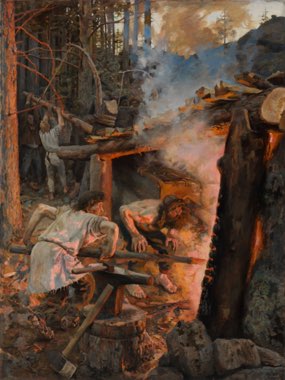
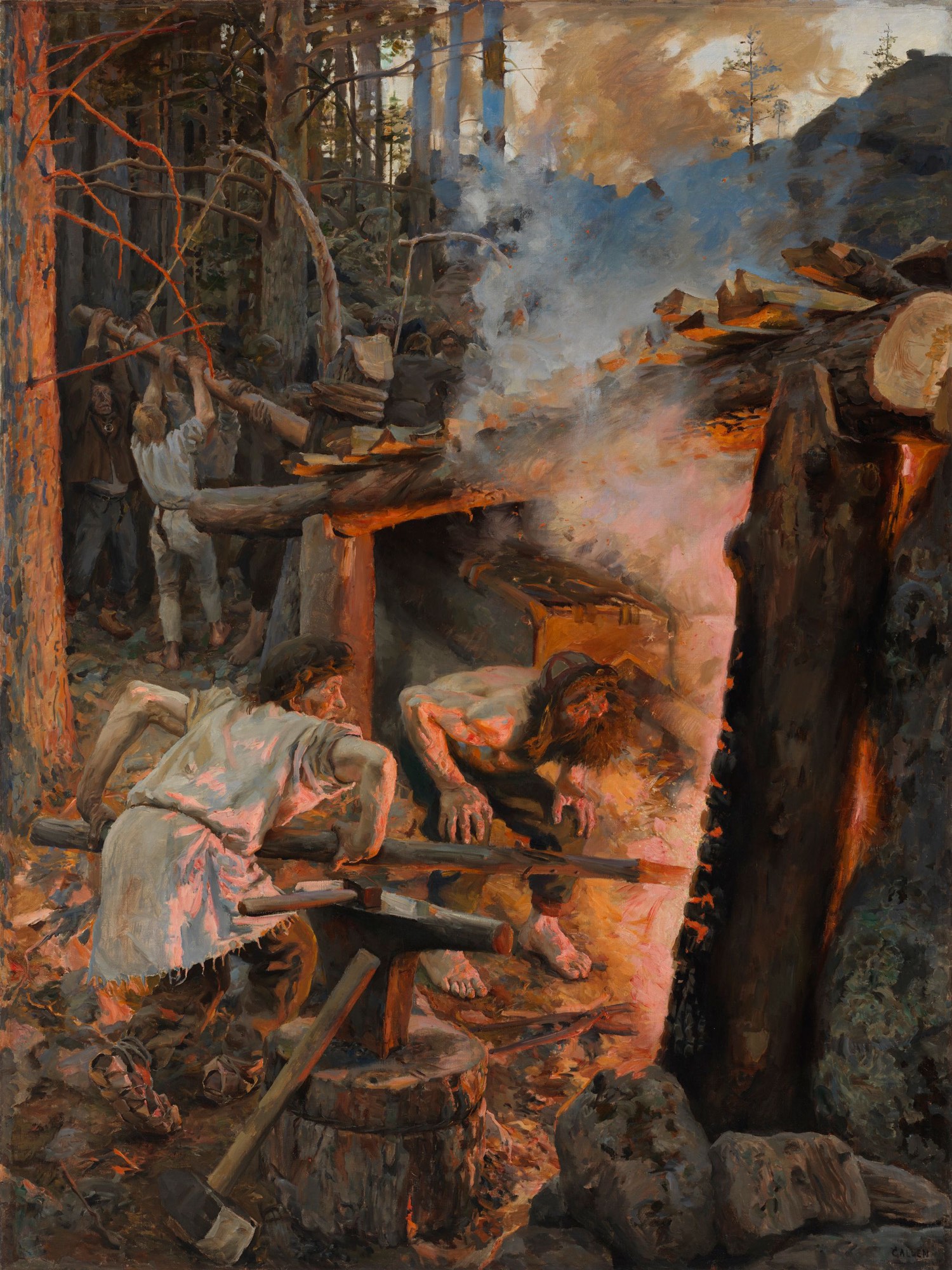
The Forging of the Sampo Canto 10 · Lines 281–432Sammon taonta (The Forging of the Sampo). Akseli Gallen-Kallela, 1893. Read the scene: Ilmarinen forges the Sampo, canto 10, lines 281–432 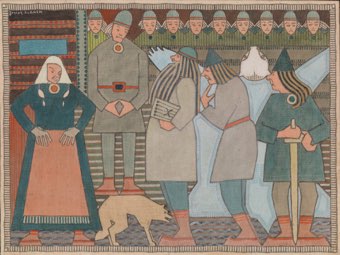
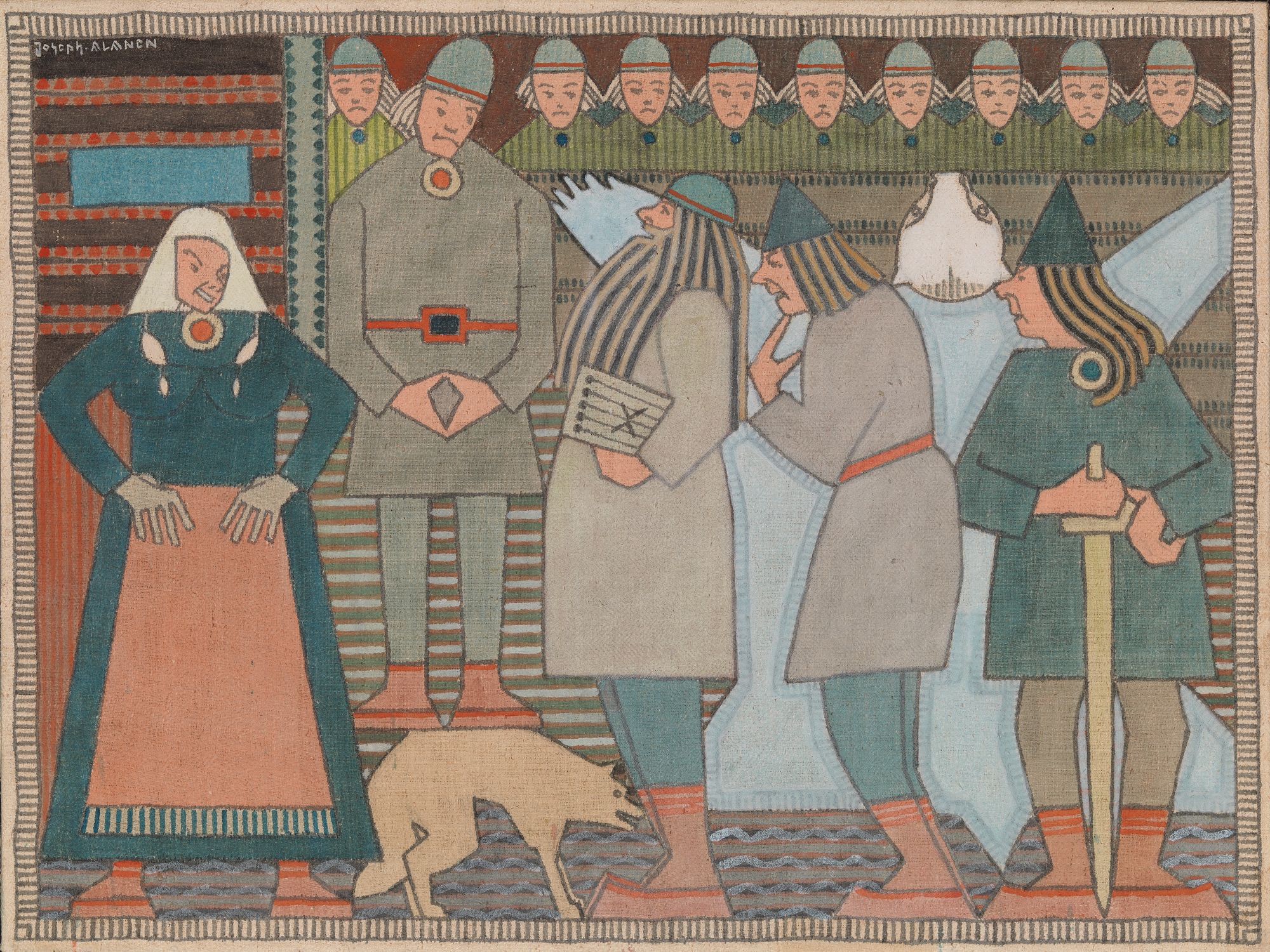
Väinämöinen, Ilmarinen and Lemminkäinen Arrive in Pohjola Canto 42 · Lines 1–58Väinämöisen, Ilmarisen ja Lemminkäisen tulo Pohjolaan (Väinämöinen, Ilmarinen and Lemminkäinen Arrive in Pohjola). Joseph Alanen, undated. Read the scene: The three heroes arrive in Pohjola, canto 42, lines 1–58 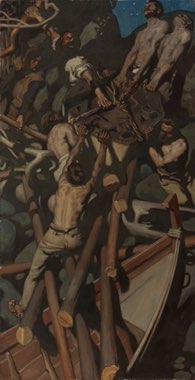
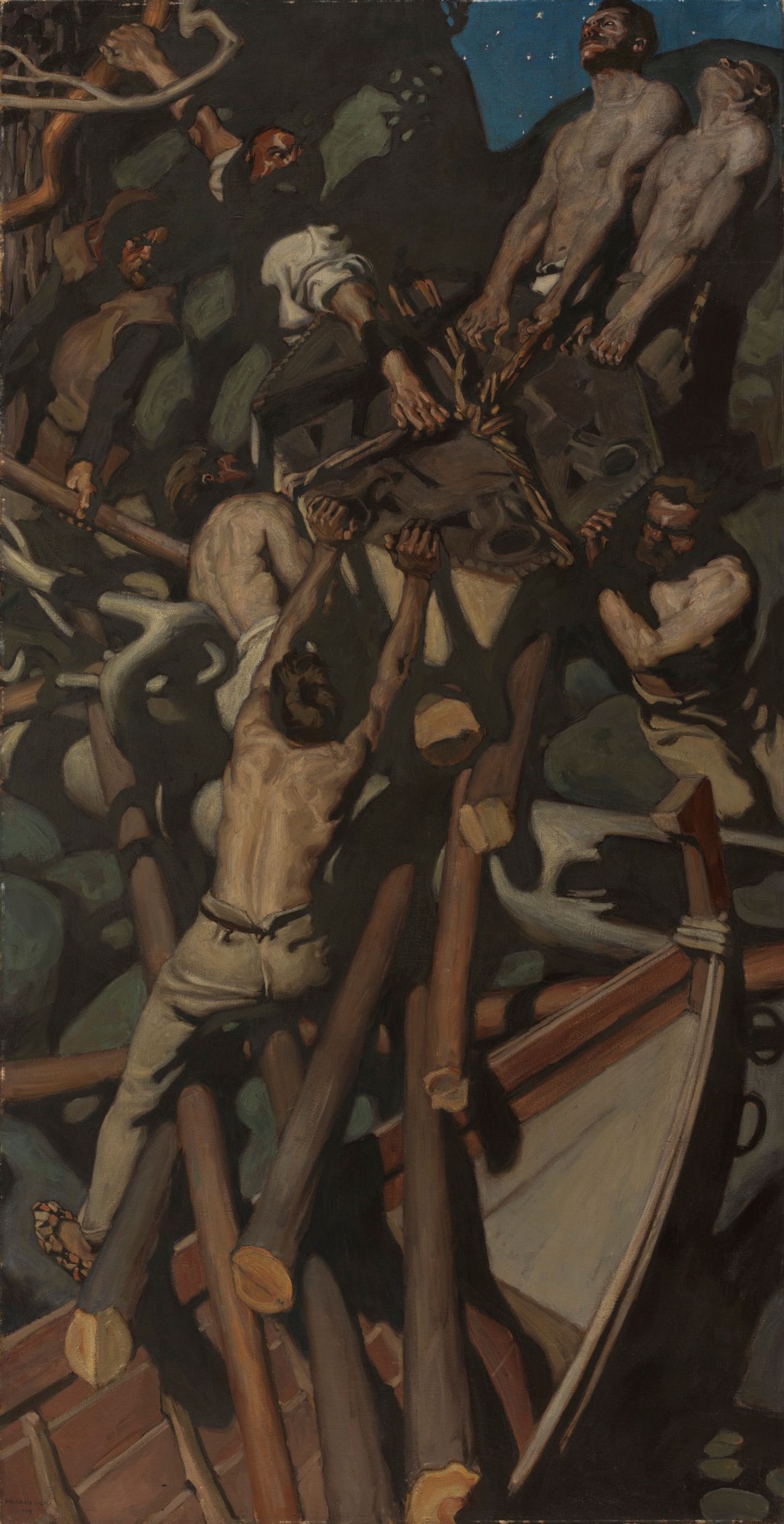
The Theft of the Sampo Canto 42 · Lines 65–164Sammon ryöstö (The Theft of the Sampo). Akseli Gallen-Kallela, 1905. Read the scene: The heroes take the Sampo out of the stone mountain, canto 42, lines 65–164
Song types (SKVR and ERAB songs; JR records carry none)
Sammon ryöstö, Sammon taonta, Väinämöisen ammunta, Maailmansyntyruno, Kilpakosinta, Kanteleen soitto, Laivaretki, Kanteleen synty, Pistoksen synty, Pistos, Vieraalle maalle joutunut, Lemminkäisen virsi
The full list, with the number of songs, is under Counts.
The cantos where Louhi appears
- Canto 7
Väinämöinen swims for several days on the open sea. The eagle, grateful to him for having spared the birch-tree for him to rest on, when he was felling the trees takes Väinämöinen on his wings, and carries him to the borders of Pohjola, where the Mistress of Pohjola takes him to her abode, and receives him hospitably. Väinämöinen desires to return to his own country, and the Mistress of Pohjola permits him to depart, and promises him her daughter in marriage if he will forge the Sampo in Pohjola. Väinämöinen promises that when he returns home he will send the smith Ilmarinen to forge the Sampo, and the Mistress of Pohjola gives him a horse and a sledge to convey him home.
- Canto 10
Väinämöinen reaches home and urges Ilmarinen to depart to woo the Maiden of Pohja, because he would be able to forge a Sampo. Ilmarinen refuses to go to Pohjola, but Väinämöinen conveys him thither without his consent by a stratagem. Ilmarinen arrives in Pohjola, where he is very well received, and promises to forge a Sampo. He forges the Sampo, and the Mistress of Pohjola conceals it in the Rocky Mountain of Pohjola. Ilmarinen asks for the maiden as his reward, but she makes excuses, saying that she is not yet ready to leave home. Ilmarinen receives a boat, returns home, and informs Väinämöinen that he has forged the Sampo in Pohjola.
- Canto 12
Kyllikki forgets her oath and goes to the village, whereupon Lemminkainen is enraged and resolves to divorce her immediately, and to set forth to woo the Maiden of Pohja. His mother does her utmost to dissuade him, telling him that he will very probably be killed. Lemminkainen, who is brushing his hair, throws the brush angrily out of his hand and declares that blood shall flow from the brush if he should come to harm. He makes ready, starts on his journey, comes to Pohjola, and sings all the men out of the homestead of Pohjola; and only neglects to enchant one wicked cowherd.
- Canto 13
Lemminkainen asks the old woman of Pohja for her daughter, but she demands that he should first capture the Elk of Hiisi on snowshoes. Lemminkainen starts off in high spirits to hunt the elk, but it escapes, and he breaks his snowshoes and spear.
- Canto 14
Lemminkainen invokes the forest deities, and at length succeeds in capturing the elk, and brings it to Pohjola. Another task is given him, to bridle the fire-breathing steed of Hiisi. He bridles it and brings it to Pohjola. A third task is assigned him, to shoot a swan on the river of Tuonela, Lemminkainen comes to the river, but the despised cowherd, who is lying in wait for him, kills him, and casts his body into the cataract of Tuoni. The son of Tuoni then cuts his body to pieces.
- Canto 15
One day blood begins to trickle from the hair-brush at Lemminkainen's home, and his mother at once perceives that death has overtaken her son. She hastens to Pohjola and inquires of Louhi what has become of him. The Mistress of Pohjola at length tells her on what errand she has sent him, and the sun gives her full information of the manner of Lemminkainen's death. Lemminkainen's mother goes with a long rake in her hand under the cataract of Tuoni, and rakes the water till she has found all the fragments of her son's body, which she joins together, and succeeds in restoring Lemminkainen to life by charms and magic salves. Lemminkainen then relates how he perished in the river of Tuonela, and returns home with his mother.
- Canto 18
Väinämöinen sets sail in his new boat to woo the Maiden of Pohja. Ilmarinen's sister sees him, calls to him from the shore, learns the object of his journey, and hastens to warn her brother that a rival has set forth to Pohjola to claim the bride. Ilmarinen makes ready, and rides on horseback to Pohjola along the shore. The Mistress of Pohjola sees the suitors approaching, and advises her daughter to choose Väinämöinen. But the daughter herself prefers Ilmarinen, the forger of the Sampo, and tells Väinämöinen, who is first to arrive, that she will not marry him.
- Canto 19
Ilmarinen arrives at the homestead of Pohjola, woos the daughter of the house, and perilous tasks are assigned to him. Aided by the advice of the Maiden of Pohja he succeeds in performing the tasks successfully. Firstly, he ploughs a field of serpent, secondly, he captures the Bear of Tuoni and the Wolf of Manala, and thirdly, he captures a large and terrible pike in the river of Tuonela. The Mistress of Pohjola promises and betroths her daughter to Ilmarinen. Väinämöinen returns from Pohjola in low spirits, and warns every one against going wooing in company with a younger man.
- Canto 20
An enormous ox is slaughtered in Pohjola. They brew ale and prepare a feast. They dispatch messengers to invite the heroes to the wedding, but Lemminkainen is expressly passed over.
- Canto 21
The bridegroom and his party are received at Pohjola. The guests are hospitably entertained with abundance of food and drink. Väinämöinen sings and praises the people of the house.
- Canto 22
The bride is prepared for her journey and is reminded of her past life and of the altered life that now lies before her. She becomes very sorrowful. They bring her to weeping. She weeps. They comfort her.
- Canto 27
Lemminkainen comes to Pohjola and behaves with the greatest insolence. The Lord of Pohjola grows angry, and as he can do nothing against Lemminkainen by magic, he challenges him to a duel. In the course of the duel Lemminkainen strikes off the head of the Lord of Pohjola, and to avenge this, the Mistress of Pohjola raises an army against him.
- Canto 30
Lemminkainen goes to ask his former comrade-in-arms, Tiera, to join him in an expedition against Pohjola. The Mistress of Pohjola sends the Frost against them, who freezes the boat in the sea, and almost freezes the heroes themselves in the boat, but that Lemminkainen restrains it by powerful charms and invocations. Lemminkainen and his companion walk across the ice to the shore, wander about in the waste for a long time in a miserable plight, and at last make their way home.
- Canto 38
Ilmarinen goes to Pohjola to woo the younger sister of his first wife, but as he receives only insulting words in reply, he becomes angry, seizes the maiden, and starts on his homeward journey. On the way the maiden treats Ilmarinen with contempt, and provokes him till he changes her into a seagull. When Ilmarinen comes home, he relates to Väinämöinen how the inhabitants of Pohjola live free from care since they possessed the Sampo; and also tells him how badly his wooing has prospered.
- Canto 42
The heroes arrive at Pohjola, and Väinämöinen announces that he has come to take possession of the Sampo, either with good-will, or by force. The Mistress of Pohjola refuses to yield it either by consent or by compulsion, and calls together her people to oppose him. Väinämöinen takes the kantele, begins to play, and lulls to sleep all the people of Pohjola, and goes with his companions to search for the Sampo; they take it from the stone mountain and convey it to the boat. They sail homewards well satisfied, carrying the Sampo with them. On the third day the Mistress of Pohjola wakes from her sleep, and when she finds that the Sampo has been carried off, she prepares a thick fog, a strong wind, and other impediments, to oppose the robbers of the Sampo, which reach the vessel, and during the tempest Väinämöinen's kantele falls into the water.
- Canto 43
The Mistress of Pohjola equips a war-vessel and goes in pursuit of the robbers of the Sampo. When she overtakes them a fight ensues between the forces of Pohjola and Kalevala in which the latter conquer. Nevertheless the Mistress of Pohjola succeeds in dragging the Sampo from the boat into the lake, where it breaks to pieces. The larger portions sink in the lake, and form its riches, while the smaller pieces are thrown on shore by the waves, at which Väinämöinen is much pleased. The Mistress of Pohjola threatens to send all evil upon Kalevala, to which Väinämöinen pays no attention. The Mistress of Pohjola returns home in great distress, taking with her only a small fragment of the cover of the Sampo. Väinämöinen carefully collects the fragments of the Sampo on the shore, and plants them, hoping for continuous good fortune.
- Canto 45
The Mistress of Pohjola sends terrible diseases to Kalevala. Väinämöinen heals the people by powerful incantations and unguents.
- Canto 46
The Mistress of Pohjola sends a bear to destroy the herds of Kalevala. Väinämöinen kills the bear, and a great feast is held in Kalevala in honour of the occasion. Väinämöinen sings, plays on the kantele, and hopes that a time of great happiness and prosperity is coming to Kalevala.
- Canto 47
The moon and sun descend to listen to Väinämöinen's playing. The Mistress of Pohjola succeeds in capturing them, hides them in a mountain, and steals the fire from the homes of Kalevala. Ukko, the Supreme God, is surprised at the darkness in the sky, and kindles fire for a new moon and a new sun. The fire falls to the ground, and Väinämöinen and Ilmarinen go to search for it. The Virgin of the Air informs them that the fire has fallen into Lake Alue, and has been swallowed by a fish. Väinämöinen and Ilmarinen try to catch the fish with a net of bast, but without success.
- Canto 49
Ilmarinen forges a new moon and sun but cannot make them shine. Väinämöinen discovers by divination that the moon and sun are hidden in the mountain of Pohjola, goes to Pohjola and conquers the whole nation. He sees the moon and sun in the mountain, but cannot enter. He returns home to procure tools with which to break open the mountain. While Ilmarinen is forging them, the Mistress of Pohjola, fearing that it may go ill with her, releases the moon and sun. When Väinämöinen sees the moon and sun reappear in the sky, he salutes them, hoping that they will always go brightly on their course, and bring happiness to the country.
Summaries: W. F. Kirby, 1907, from Lönnrot's summaries in the 1849 edition.
Counts
Songs naming Louhi or a mistress of Pohjola: 355.
Songs naming Louhi: 12. Songs naming a mistress of Pohjola (Pohjolan emäntä, Pohjan akka and other forms): 355. Songs with either: 355. Lönnrot made the two into one figure; the songs are not counted here as naming the same one.
By collection: SKVR 301; JR 54.
Regions, with the number of songs (a region counts every song from any of its places once): Viena 145, Pohjois-Karjala 53, Aunus 37, Laatokan Karjala (Raja-Karjala) 29, Keski-Suomi 20, Etelä-Savo 19, Pohjois-Savo 15, Kainuu 14, Pohjois-Pohjanmaa 8, Keski-Inkeri 6, Etelä-Karjala 3, Peräpohjola 2, Etelä-Pohjanmaa 1, Häme 1, Itä- ja Pohjois-Inkeri 1, Varsinais-Suomi 1.
Places on the map, with the number of songs (a song given two places counts at both): Vuokkiniemi 81, Kiimaisjärvi 28, Ilomantsi 25, Uhtua 24, Kontokki 18, Suistamo 14, Kitee 13, Kivijärvi 12, Jyskyjärvi 11, Pistojärvi 9, Porajärvi 7, Sotkamo 6, Etelä-Savo 5, Kaprio 5, Kesälahti 5, Salmi 5, Juva 4, Kaavi 4, Maaninka 4, Pihtipudas 4, Suojärvi 4, Suomussalmi 4, Kerimäki 3, Nilsiä 3, Soanlahti 3, Viitasaari 3, Impilahti 2, Kainuu 2, Karttula 2, Kiuruvesi 2, Kuopio mlk 2, Kärsämäki 2, Pohjois-Pohjanmaa 2, Repola 2, Savonranta 2, Suonenjoki 2, Eno 1, Haapajärvi 1, Halikko 1, Häme 1, Joroinen 1, Jäppilä 1, Keitele 1, Kiestinki 1, Koivisto 1, Kontiolahti 1, Korpiselkä 1, Kuhmo 1, Metsäpirtti 1, Nurmes 1, Piippola 1, Puolanka 1, Pyhäjärvi Ol. 1, Rantasalmi 1, Rautavaara 1, Rautu 1, Ristiina 1, Rovaniemi 1, Rääkkylä 1, Rääpyvä 1, Savitaipale 1, Serepetta 1, Sodankylä 1, Säyneinen 1, Tyrnävä 1, Töysä 1, Viena 1.
Songs whose record gives no place that can be put on the map: 1.
The ten places with the most songs account for 235 of the 354 songs that have a place on the map (66%).
SKVR and ERAB songs without a song type: 1 of 301 (0%).
Song types, with the number of songs: Sammon ryöstö 70, Sammon taonta 70, Väinämöisen ammunta 63, Maailmansyntyruno 48, Kilpakosinta 41, Kanteleen soitto 33, Laivaretki 28, Kanteleen synty 27, Pistoksen synty 23, Pistos 23, Vieraalle maalle joutunut 22, Lemminkäisen virsi 21, Tautien synty 21, Karhua vastaan 18, Kultaneito 16, Taivaan taonta 16, Tulen sanat 15, Metsälle lähtiessä 12, Vipusen virsi 12, Kilpalaulanta 11, Koiran synty 11, Saaren neidot 10, Tulen synty 10, Karhun synty 9, Polvenhaava 8, Purren itku 8, Riiden synty 8, Riisi 8, Veneenveisto 8, Tuonelassa käynti 6, Iivana Kojosenpoika 5, Kalevanpojan kosto 5, Koira päästetään pilauksesta 5, Lemminkäisen surma 5, Polin puulle pyörivälle 5, Päivän päästö 5, Ähkyn synty 5, Hiiden hirven hiihdäntä 4, Jäniksen metsästys 4, Karkotussanoja 4, Mitä istut isännän poika 4, Parempi on omalla maalla ropehesta vettä juoda 4, Rutsa 4, Suden synty 4, Tietäjän apurin synty 4, Ähky 4, Ihmehevonen 3, Oluen uhkaus 3, Vellamon neidon onginta 3, Verensulku 3, Ylösnousemusvirsi 3, Ammus eläimessä 2, Erilaisia parannusloitsuja 2, Hammastaudin synty 2, Hammastauti 2, Hiidestä kosinta 2, Ilmarisen takominen 2, Iso tammi 2, Karhun metsästys 2, Karhun pureman parantaminen karjasta 2, Kyynelten vierintä 2, Käärmeen sanat 2, Käärmeen synty 2, Laula, laula, kieli keito 2, Läävämadon synty 2, Läävämato 2, Oikein on otavat tehty 2, Paise 2, Pakkasen sanat 2, Pakkasen synty 2, Raani 2, Raanin synty 2, Raudan sanat 2, Raudan synty 2, Sutta vastaan 2, Tapanin virsi 2, Tulehenko teen tupani 2, Voiteen synty 2, Ahdin ja Kyllikin runo 1, Alahalla allin mieli 1, Ammuksen synty 1, Annikaisen virsi 1, Avunpyyntö 1, Haittan' on hako vesillä, köyhät eellä rikkahalla 1, Herhiläisen tai mehiläisen synty 1, Hääväki varataan 1, Ihmetupa 1, Ihmisen synty 1, Iso härkä 1, Isälle ja vieraalle jauhaminen, soutaminen 1, Joka puu puree, joka sammakko sanoo 1, Jumala on pesemättä puhtukainen 1, Kalervo ja Untamo 1, Karhun pidätys ja lumous 1, Karhunpeijaiset 1, Karjaa laitumelle laskettaessa 1, Kaskenpoltto 1, Kerskaukset ja varaukset 1, Ketun metsästys 1, Kirot 1, Koirasta hyvä metsäkoira 1, Kunne kurja luomme luotu poika 1, Kylvetyssanoja 1, Käärmeen pureman historiola 1, Käärmetuoppi 1, Lapista, Turjan maalta, lintu, yksi siipi vettä viisti 1, Lapsen itkettäjä 1, Lauri Lappalainen 1, Lemmennostoloitsut 1, Luonnon nostatus 1, Luulin lumpehen pitävän 1, Löylyn luku 1, Löylyn synty 1, Marjavirsi 1, Mataleenan virsi 1, Metsästä tarttuu 1, Metsästäjän varautuminen kateita vastaan 1, Miehen kolme pahaa 1, Miekan tai keihään kuvaus 1, Miten ollen, kuin elänen 1, Mitä tehä miun poloisen tämän suuren huolen kanssa 1, Nuotalla 1, Nuotan synty 1, Näin ennen eukko, isä lauloi 1, Ohran kylvö 1, Oli meitä ennen paljon 1, Oravan metsästys 1, Osallisen onni valvoi, minun makasi 1, Paiseen synty 1, Pani lesket leikkoamahan 1, Poron synty 1, Puun sanat 1, Puun synty 1, Rikkaan raha kuluu, köyhän raiskan pää menee 1, Rikkeet 1, Ruosteen poistaminen viljasta 1, Ruosteen synty 1, Saunanhakuvirsi 1, Sijan tiedän, missä synnyin 1, Sotaan lähtiessä 1, Suden purema 1, Synnytys 1, Syntymistään sureva 1, Sämpsä Pellervoinen 1, Tuli ukko Turjan maalta 1, Vedestä tarttuu 1, Vesi vanhin veljeksistä 1, Vesihiiden synty 1, Vesille venehen mieli, naisen miehelään 1, Viljanleikkaajan sanoja 1, Väinämöisen tuomio 1, Ähky eläimessä 1.
Spellings of the name, with the number of songs: pohjolan emäntä 166, pohjan akka 76, pohjon akka 41, pohjan eukko 28, pohjoilan emäntä 13, louhi 11, pohjoin akka 7, pohjolan emändä 7, pohjolan emännän 6, pohjon eukko 5, pohjan emäntä 4, pohjoilan emändä 4, pohjon akk 4, pohjan akk 3, pohjanakka 3, pohjolan akka 3, pohjalan emändä 2, pohjan ämmän 2, pohjasen emäntä 2, pohjolan emantä 2, pohjon akalta 2, pohjon akan 2, louhelta 1, louki 1, pohjan akalla 1, pohjan akalta 1, pohjan akan 1, pohjan akkaa 1, pohjan ämmä 1, pohjin eukko 1, pohjn emäntä 1, pohjoilan akangi 1, pohjoilan akanne 1, pohjoin akalla 1, pohjolan akan 1, pohjolan emännällä 1, pohjolan emännältä 1, pohjolan emännät 1, pohjolan emänta 1, pohjolan emänät 1, pohjolan ämmän 1, pohjolanemäntä 1, pohjon emäntä 1, pohjon eukkoo 1, pohjosen emäntä 1, pohjozen emändu 1, pohjozen emändä 1, pohjulan emäntä 1.
Not counted: texts an editor reworked or put together, lines quoted in early scholars' books and papers, texts from early anthologies, poems the archive's editors doubted were folk poetry, composed poems, and texts learned from the Kalevala or other print: JR 02205, JR 02456, JR 02460, JR 02542, JR 03086, JR 03361, JR 03371, JR 06003, JR 30733, JR 38413, JR 39446, JR 39730, JR 48206, JR 66679, JR 68823, JR 80696, JR 85375, JR 85474, JR 85478, SKVR VI2 4818, SKVR VII4 loitsut 2862, SKVR XII2 5408, SKVR XII2 6346, SKVR XII2 6577, SKVR XII2 6807, SKVR XV 310, SKVR XV 327, SKVR XV 330.
Not counted a second time: 71 texts that copy a record held elsewhere in the collections (fair copies, copies among another collector's papers, excerpts printed separately).
In songs recorded at Porajärvi between 1871 and 1909 the name Pohjan akka stands joined to Väinämöinen's, as pohjan akka väinämöinen. Each song is counted by what the figure does: in the songs of the boat journey and the kantele it does what Väinämöinen does in other songs, and the song counts for him; in the feast song it brings the beer, the hostess's part, and the song counts here.
About this page
A song counts on this page when it names Louhi or a mistress of Pohjola, in any spelling. A song counts once, however often the name occurs in it. The numbers say how many songs name the figure, not how many songs are about it.
The songs are the folk songs in RunoVerse from the SKVR and JR collections of the Finnish Literature Society and from the Estonian Folklore Archives (ERAB). Literary texts are left out: Lönnrot's Kalevala and its earlier versions, the Kanteletar and the other works of the KR corpus. So are songs that the archive files as learned from the Kalevala, and texts that turned out on reading to be an editor's reworking or compilation, lines quoted in early scholars' books and papers, texts from early anthologies, poems the archive's editors doubted were folk poetry, composed poems or texts learned from print, or to follow the printed Kalevala line by line; they are listed under Counts. An early print that is the only surviving record of a song is counted, and so are songs in which the archive's editors saw only some influence of print. When the collections hold one record twice, as a fair copy, as a copy among another collector's papers or as an excerpt printed separately, it counts once.
Each spelling of the name was sorted. Spellings that can only be the name count as they stand. Spellings that are also ordinary words or other names (aino 'only', for instance, or Ahti, also the name of a water god) were decided line by line, each line read in its song. The sorting and the line decisions were made by the AI model Claude Opus 5.5.
The places are those the archive records give: usually the place where the song was written down, for some songs the singer's home parish. A dashed circle marks a region named without a more exact place. A song given two places counts at both.
The cantos are those of Lönnrot's Kalevala of 1849 in which the figure is named. Under each canto is W. F. Kirby's summary of 1907.