What is a runosong (runolaulu, regilaul)?
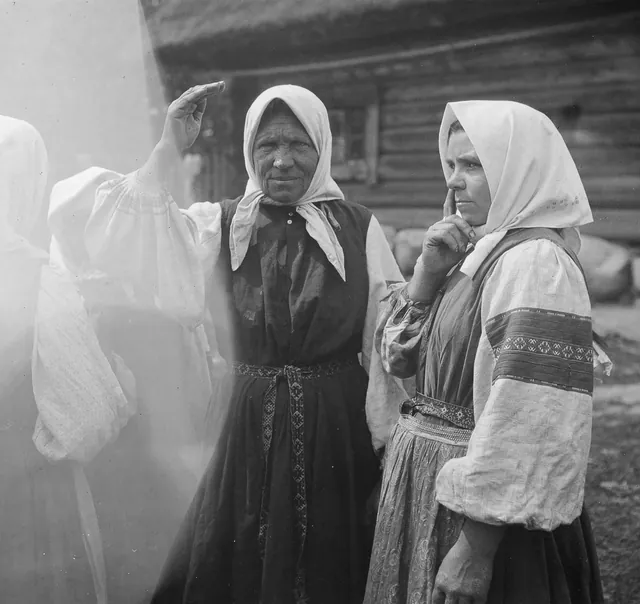
Runosong is an old oral song tradition shared by most Finnic peoples: Finns, Karelians, Ingrians (Izhorians and Ingrian Finns), Votians and Estonians, including the Setos, who call their songs leelo. In Finnish it is runolaulu, in Estonian regilaul. It is one tradition with many regional forms: the same plots and images, and closely related lines, recur from region to region, each in the local language or dialect, from Setomaa on the Estonian–Russian border to Viena Karelia.
How the songs are made
Runosongs share one poetic system. Lines are short, with a falling, trochaic rhythm and four stresses; most have about eight syllables, though in Estonia a line could have from six to twelve. Words within a line often begin with the same sound (alliteration), and a line is often followed by another that says the same thing in other words (parallelism). The lines follow one another without stanzas and are not bound by end rhyme.
Singers drew on a shared stock of lines and formulas, and no two performances were quite alike. Often a lead singer sang each line and the others repeated it, which was the usual way in Estonia, Setomaa and Ingria; songs were also sung alone, and in Karelia two singers often sang epic songs together. Each recorded text is usually one variant of a song, as one singer or group sang it at one time.
What was sung
The tradition includes narrative songs (in Karelia and Ingria above all about the making of the world and mythical heroes, in Estonia mostly ballad-like songs), lyric songs, songs about singing itself, wedding songs, calendar songs for the feasts of the year, work and herding songs, lullabies and children's songs, swing songs and game songs. Charms used the same verse form, but they were often recited rather than sung, and most of those in RunoVerse were collected in Finland and Karelia. The archives sort the songs into thousands of types; RunoVerse has a page for each of the 445 types with at least 100 poems.
How the songs were written down
Runosong lived in singing, not in writing. The oldest dated text in RunoVerse is a single charm from 1564, and dated texts stay rare until the 19th century; nearly nine in ten of the dated poems were written down between the 1830s and the 1930s. By then, in most regions, the old songs were giving way to newer rhymed songs in stanzas, and the archives hold some of those too. The collectors included Elias Lönnrot and the up to 1,400 correspondents whom Jakob Hurt enlisted from 1888 in Estonia and in Estonian settlements in Russia; the archives name more than 7,000 collectors in all, many of them local people: villagers, teachers, pupils and students.
Lönnrot compiled his Kalevala (1835, 1849) from collected song lines, which he combined and reworked; Kreutzwald's Kalevipoeg (1857–1861) is mostly his own verse in imitation of regilaul, built on prose legends about the giant Kalevipoeg. Both are authored epics, not oral songs; RunoVerse files them separately, as the KR corpus of literary poems.
Where to start in RunoVerse
- A place. Each of the 803 collection places has a page with its songs, collectors and collection years: for example Vuokkiniemi in Viena Karelia, Soikkola in Ingria, Kuusalu in northern Estonia and Setumaa, the archive's name for Setomaa.
- A song type. Some songs were sung across much of the Finnic area. The song of the maiden to be ransomed is filed as Lunastettava neito in the Finnish archive's SKVR (414 poems from 112 places) and as Lunastatav neiu in the Estonian archive's ERAB (254 poems from 81 places). The song of the great oak is Iso tammi in SKVR (303 poems from 51 places, mostly in Ingria and Karelia) and Suur tamm in ERAB (345 poems from 85 places).
- A single song. Each type page lists example poems, and each opens in the reader with its original text.
- The sources. RunoVerse brings together roughly 290,000 poems from four corpora: SKVR, KR and JR of the Finnish Literature Society, and ERAB of the Estonian Folklore Archives. The About page describes them and says how to cite them.