Lemminkäinen in the Kalevala and the folk songs
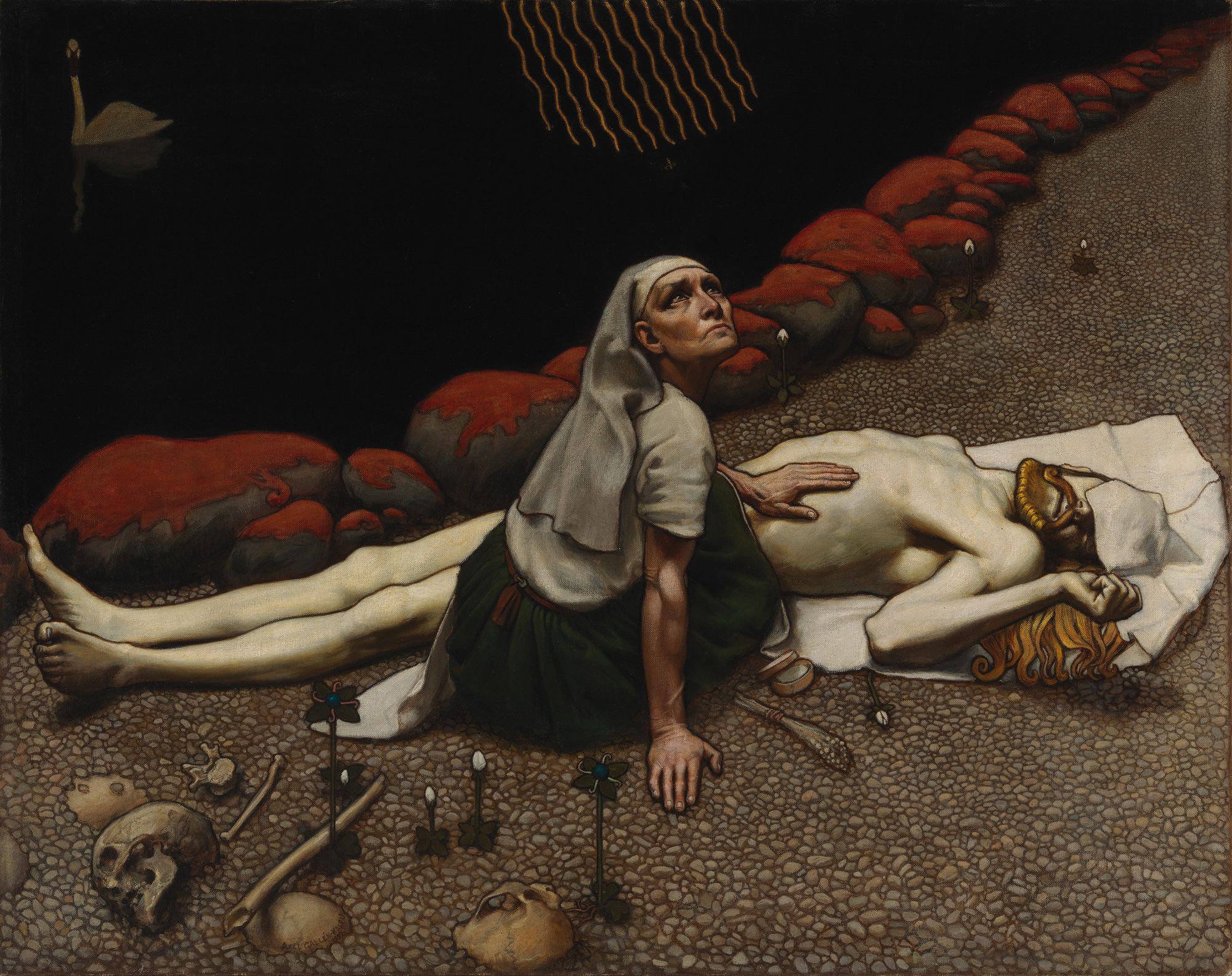
In the Kalevala
Lemminkäinen carries off Kyllikki from the Island, and when she breaks her oath and goes to the village, he leaves her to woo the maiden of Pohjola (cantos 11–12). The mistress of Pohjola sets him tasks: he catches Hiisi's elk and bridles Hiisi's fire-mouthed gelding, but at the river of Tuonela, where he is sent to shoot the swan, the herdsman he had scorned kills him and throws him into the rapids (cantos 13–14). His mother rakes the pieces of his body out of the river of Tuonela and brings him back to life (canto 15). Left out of the wedding at Pohjola, he goes there all the same, strikes off the head of the master of Pohjola and flees to an island across the sea (cantos 26–29); later he joins Väinämöinen and Ilmarinen on the voyage for the Sampo (canto 39).
Written for RunoVerse by the AI model Claude Opus 5.5 from Lönnrot's summaries of the cantos.
In the folk songs
434 songs in the archive collections name Lemminkäinen, or Ahti Saarelainen, Kaukomieli or Kaukamoinen; Lönnrot's Kalevala uses Ahti Saarelainen and Kaukomieli as other names of Lemminkäinen. In Ingrian songs Kaukamoinen is called the son of Kalervo, and whether the songs mean one figure is not decided here. Their records place nearly half of the songs in Viena Karelia and most of the rest in Ladoga Karelia and Olonets Karelia (Aunus); songs that use only the other names are also placed in Ingria. More than half are filed as the song of Lemminkäinen; next come the maidens of the island and the death of Lemminkäinen.
These lines in Lönnrot's Kalevala
Kalevala, 1849, canto 20, lines 565–567, 575–576
Folk song: SKVR I2 808, Vuokkiniemi, 1872
Lönnrot's Kalevala of 1849 has lines like these in canto 20; the marked words are in both texts, some in another form. This song was written down in 1872, after the Kalevala appeared.
English under the folk-song lines: translated for RunoVerse by the AI model Claude Fable 5.2. English under the Kalevala lines: W. F. Kirby, 1907.
Compare side by side · Open the song in the poem reader · Read canto 20 with Kirby's English
Lines from the folk songs
One line from the earliest record of known year at each of the ten places with the most songs. The name is marked.
- Itse kaunis Kauko Mieli — SKVR I2 774, Vuokkiniemi, 1821
- Naittaja lieto Lemminkäinen." — SKVR VII1 380, Suistamo, 1845
- Elä kutsu Lemmingäistä; — SKVR I2 728, Kontokki, 1820
- Yhtä ei kutsu Lemminkäistä, — SKVR II 213, Repola, 1839
- Eip' on kutsunt Kaukomieltä. — SKVR I2 828, Uhtua, 1834
- Lemminkäinen lieto poika — SKVR I2 713, Kiimaisjärvi, 1845
- Luotti lieto Lemminkäinen, — SKVR VII1 357, Ilomantsi, 1845
- "Ele kutsu Lemminkäistä, — SKVR II 194, Porajärvi, 1845
- Yhtä ei kutsunt Kaukomieltä. — SKVR I2 701, Jyskyjärvi, 1835
- Tuohon kaatoi Kaukamoi. — SKVR IV1 1435, Kaprio, 1861
Where the archive records place the songs
The places that the archive records give for the songs naming Lemminkäinen, Ahti Saarelainen or Kaukomieli.
The places with the most songs on the map: Vuokkiniemi, Suistamo, Kontokki, Repola, Uhtua, Kiimaisjärvi, Ilomantsi, Porajärvi.
- 7 or more songs
- 3 to 6 songs
- 1 or 2 songs
- (exact place not known)
All places on the map
7 or more songs
- Vuokkiniemi
- Suistamo
- Kontokki
- Repola
- Uhtua
- Kiimaisjärvi
- Ilomantsi
- Porajärvi
- Jyskyjärvi
- Kaprio
- Pistojärvi
- Korpiselkä
- Suojärvi
3 to 6 songs
- Viena (exact place not known)
- Kainuu (exact place not known)
- Soanlahti
- Suomussalmi
- Impilahti
- Kivijärvi
- Sakkola
- Tyrö
1 or 2 songs
The name as the singers said it
The forms of the name that the collectors wrote down from the singers, each found in at least three songs. Spellings that differ only in writing are joined, and forms with a case ending, such as Lemminkäisen, are left out. Under each form: the number of songs, and the region where more than half of them were recorded.
- Lemminkäinen
- Lemminkäini
- Lemmingäine
- Lemminkäine
- Lemmingäinen
- Lemmingäin
- Lemminkäin
- Lemmingäne
- Leminkäinen
- Lemmingäini
- Lemmingöine
- Lemminkäne
- Lemminkänen
Other names
His other names in these songs, with every case form counted.
More Kalevala art
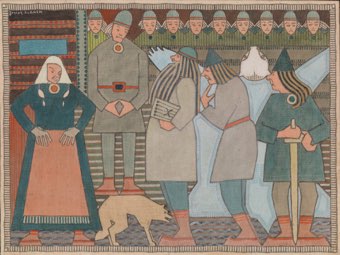
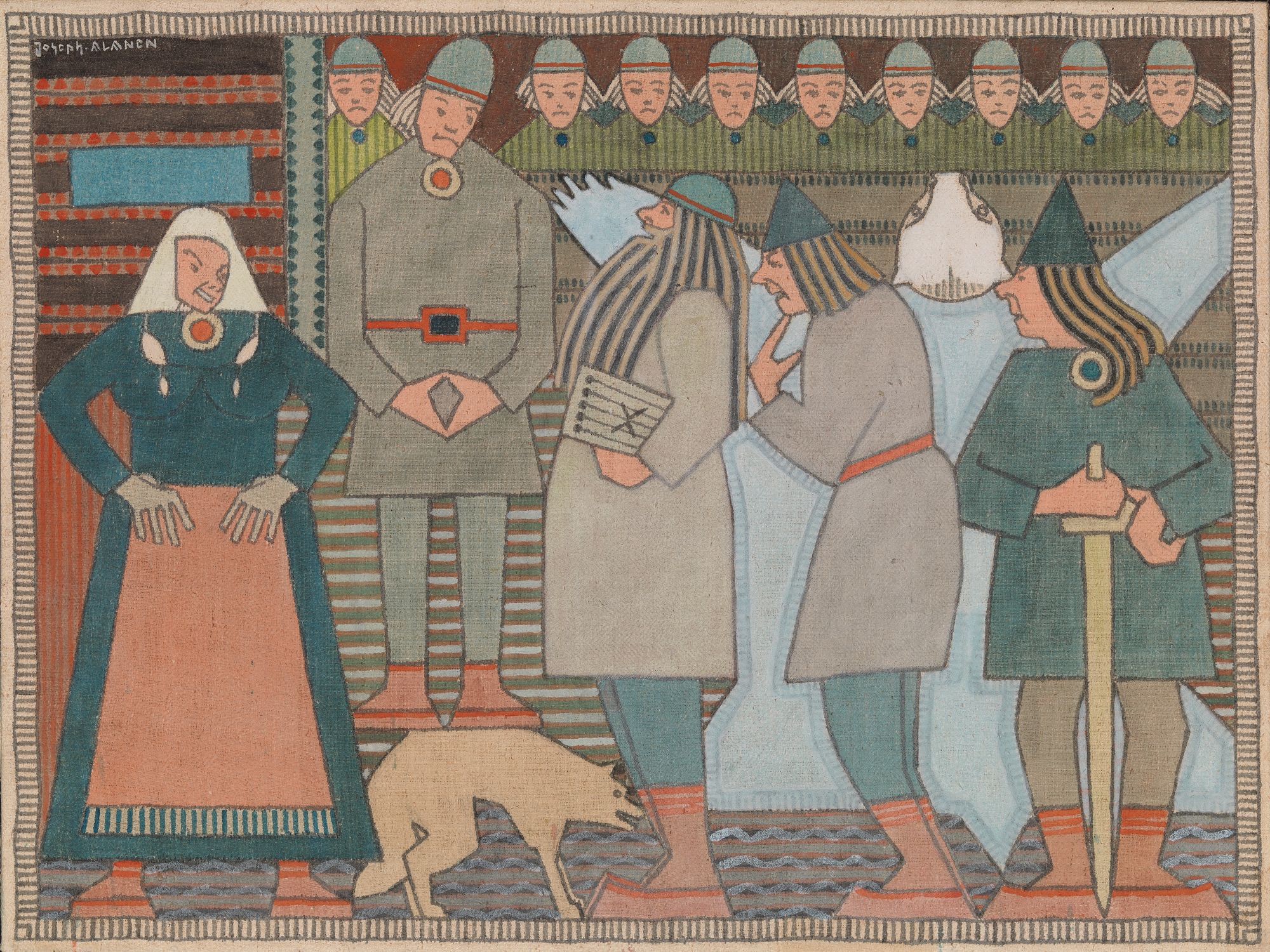
Väinämöinen, Ilmarinen and Lemminkäinen Arrive in Pohjola Canto 42 · Lines 1–58Väinämöisen, Ilmarisen ja Lemminkäisen tulo Pohjolaan (Väinämöinen, Ilmarinen and Lemminkäinen Arrive in Pohjola). Joseph Alanen, undated. Read the scene: The three heroes arrive in Pohjola, canto 42, lines 1–58 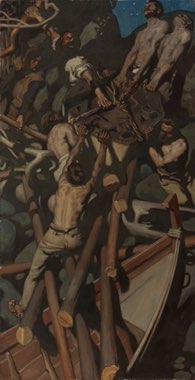
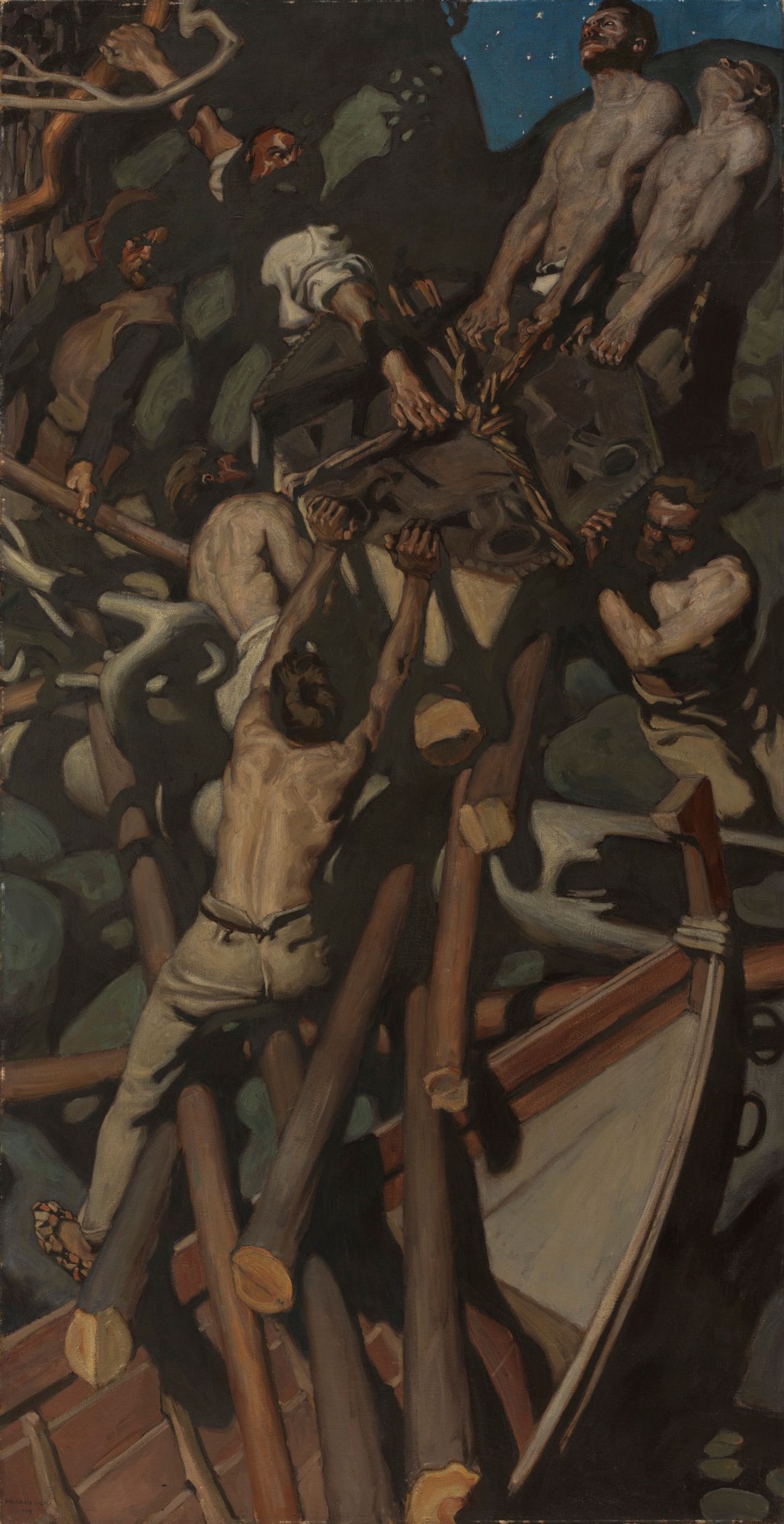
The Theft of the Sampo Canto 42 · Lines 65–164Sammon ryöstö (The Theft of the Sampo). Akseli Gallen-Kallela, 1905. Read the scene: The heroes take the Sampo out of the stone mountain, canto 42, lines 65–164 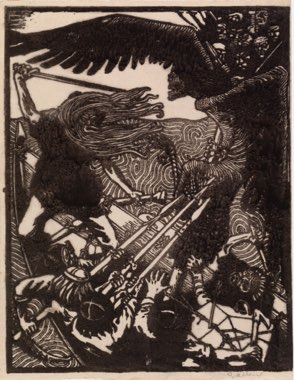
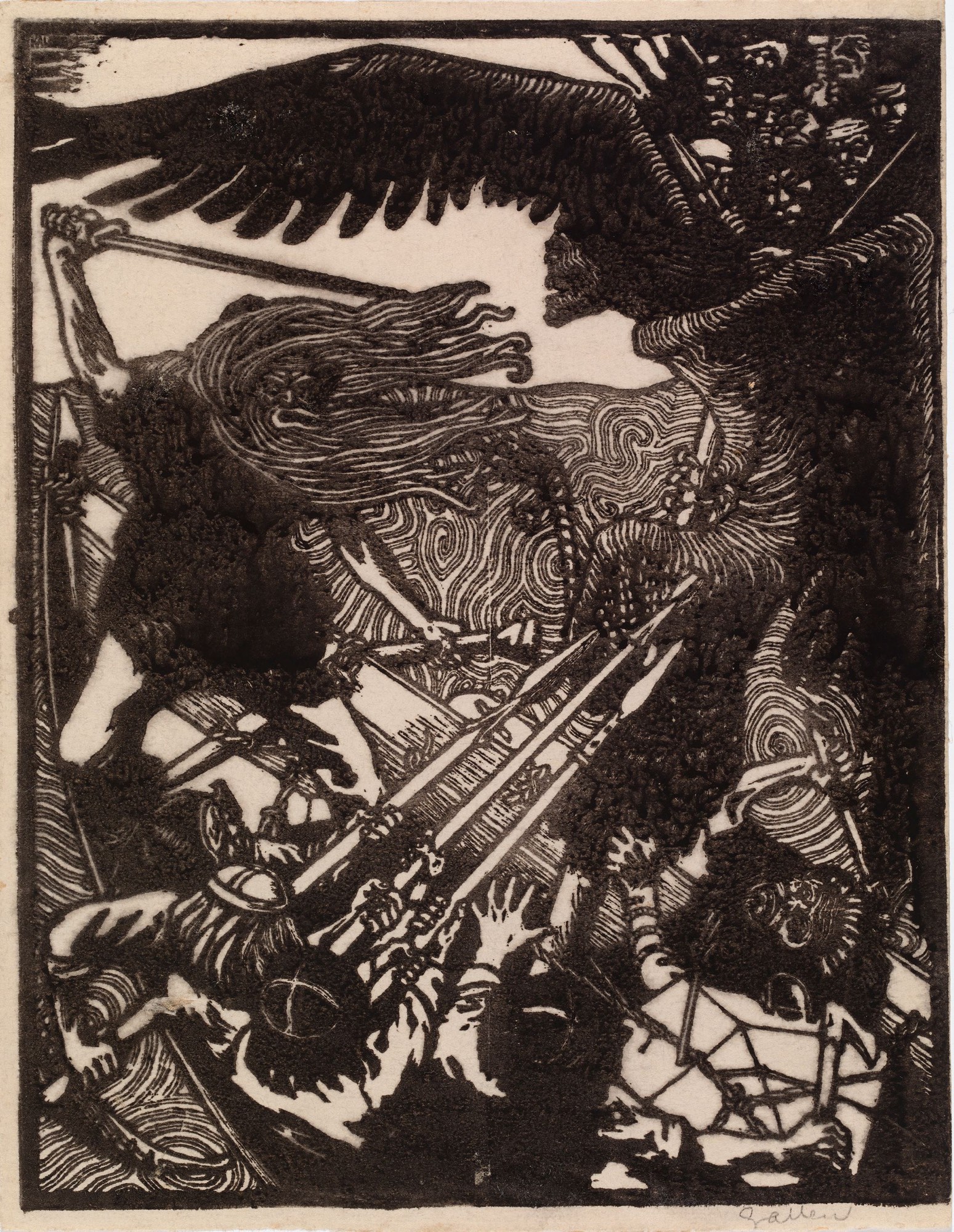
Defence of the Sampo Canto 43 · Lines 23–258Sammon puolustus (Defence of the Sampo). Akseli Gallen-Kallela, 1895. Read the scene: The mistress of Pohjola attacks the raiders of the Sampo at sea, canto 43, lines 23–258
Song types (SKVR and ERAB songs; JR records carry none)
Lemminkäisen virsi, Saaren neidot, Lemminkäisen surma, Kaukamoisen virsi, Oluen uhkaus, Vipusen virsi, Iso härkä, Laivaretki, Sammon ryöstö, Rutsa, Kalevanpojan kosto, Kilpakosinta
The full list, with the number of songs, is under Counts.
The cantos where Lemminkäinen appears
- Canto 11
Lemminkainen goes to seek a wife among the noble maidens of Saari. At first they laugh at him, but afterwards become very friendly. But Kyllikki, on whose account he has come, will not listen to him, and at length, he carries her off by force, drags her into his sledge, and drives away with her. Kyllikki weeps, and especially reproaches Lemminkainen with his fondness for war, and Lemminkainen promises not to go to war if Kyllikki promises never to go to the village dances, and both swear to observe these conditions. Lemminkainen drives home, and mother rejoices in her young daughter-in-law.
- Canto 12
Kyllikki forgets her oath and goes to the village, whereupon Lemminkainen is enraged and resolves to divorce her immediately, and to set forth to woo the Maiden of Pohja. His mother does her utmost to dissuade him, telling him that he will very probably be killed. Lemminkainen, who is brushing his hair, throws the brush angrily out of his hand and declares that blood shall flow from the brush if he should come to harm. He makes ready, starts on his journey, comes to Pohjola, and sings all the men out of the homestead of Pohjola; and only neglects to enchant one wicked cowherd.
- Canto 13
Lemminkainen asks the old woman of Pohja for her daughter, but she demands that he should first capture the Elk of Hiisi on snowshoes. Lemminkainen starts off in high spirits to hunt the elk, but it escapes, and he breaks his snowshoes and spear.
- Canto 14
Lemminkainen invokes the forest deities, and at length succeeds in capturing the elk, and brings it to Pohjola. Another task is given him, to bridle the fire-breathing steed of Hiisi. He bridles it and brings it to Pohjola. A third task is assigned him, to shoot a swan on the river of Tuonela, Lemminkainen comes to the river, but the despised cowherd, who is lying in wait for him, kills him, and casts his body into the cataract of Tuoni. The son of Tuoni then cuts his body to pieces.
- Canto 15
One day blood begins to trickle from the hair-brush at Lemminkainen's home, and his mother at once perceives that death has overtaken her son. She hastens to Pohjola and inquires of Louhi what has become of him. The Mistress of Pohjola at length tells her on what errand she has sent him, and the sun gives her full information of the manner of Lemminkainen's death. Lemminkainen's mother goes with a long rake in her hand under the cataract of Tuoni, and rakes the water till she has found all the fragments of her son's body, which she joins together, and succeeds in restoring Lemminkainen to life by charms and magic salves. Lemminkainen then relates how he perished in the river of Tuonela, and returns home with his mother.
- Canto 20
An enormous ox is slaughtered in Pohjola. They brew ale and prepare a feast. They dispatch messengers to invite the heroes to the wedding, but Lemminkainen is expressly passed over.
- Canto 26
Lemminkainen, greatly offended that he was not invited to the wedding, resolves to go to Pohjola, although his mother dissuades him from it, and warns him of the many dangers that he will have to encounter. He sets forth and succeeds in passing all the dangerous places by his skill in magic.
- Canto 27
Lemminkainen comes to Pohjola and behaves with the greatest insolence. The Lord of Pohjola grows angry, and as he can do nothing against Lemminkainen by magic, he challenges him to a duel. In the course of the duel Lemminkainen strikes off the head of the Lord of Pohjola, and to avenge this, the Mistress of Pohjola raises an army against him.
- Canto 28
Lemminkainen escapes with all speed from Pohjola, comes home and asks his mother where he can hide himself from the people of Pohjola, who will soon attack him in his home, a hundred to one. His mother reproaches him for his expedition to Pohjola, suggests various places of concealment, and at length advises him to go far across the lakes to a distant island, where his father once lived in peace during a year of great war.
- Canto 29
Lemminkainen sails across the lakes in his boat and comes safely to the island. There he lives pleasantly among the girls and women till the return of the men from warfare, who conspire against him. Lemminkainen flies from the island, much to the grief both of the girls and himself. His boat is wrecked in a violent storm, but he escapes by swimming to land, makes a new boat, and arrives safely on the shores of his own country. He finds his old house burned, and the whole surroundings laid waste, when he begins to weep and lament, especially for the loss of his mother. His mother, however, is still alive, having taken refuge in a thick forest where Lemminkainen finds her to his great joy. She relates how the army of Pohjola came and burned down the house. Lemminkainen promises to build a finer house after he has revenged himself upon the people of Pohjola, and describes his pleasant life in the island of refuge.
- Canto 30
Lemminkainen goes to ask his former comrade-in-arms, Tiera, to join him in an expedition against Pohjola. The Mistress of Pohjola sends the Frost against them, who freezes the boat in the sea, and almost freezes the heroes themselves in the boat, but that Lemminkainen restrains it by powerful charms and invocations. Lemminkainen and his companion walk across the ice to the shore, wander about in the waste for a long time in a miserable plight, and at last make their way home.
- Canto 39
Väinämöinen persuades Ilmarinen to go with him to Pohjola to bring away the Sampo. Ilmarinen consents, and the heroes start off on their journey in a boat. Lemminkainen hails them from the shore, and on hearing where they are going, proposes to join them, and is accepted as a third comrade.
- Canto 40
The Sampo-raiders come to a waterfall, beneath which the boat is caught fast on the back of a great pike. The pike is killed, and the front part is taken into the boat, cooked, and eaten. Väinämöinen makes the jaws of the pike into a kantele, on which several of the party attempt to play, but without success.
- Canto 42
The heroes arrive at Pohjola, and Väinämöinen announces that he has come to take possession of the Sampo, either with good-will, or by force. The Mistress of Pohjola refuses to yield it either by consent or by compulsion, and calls together her people to oppose him. Väinämöinen takes the kantele, begins to play, and lulls to sleep all the people of Pohjola, and goes with his companions to search for the Sampo; they take it from the stone mountain and convey it to the boat. They sail homewards well satisfied, carrying the Sampo with them. On the third day the Mistress of Pohjola wakes from her sleep, and when she finds that the Sampo has been carried off, she prepares a thick fog, a strong wind, and other impediments, to oppose the robbers of the Sampo, which reach the vessel, and during the tempest Väinämöinen's kantele falls into the water.
- Canto 43
The Mistress of Pohjola equips a war-vessel and goes in pursuit of the robbers of the Sampo. When she overtakes them a fight ensues between the forces of Pohjola and Kalevala in which the latter conquer. Nevertheless the Mistress of Pohjola succeeds in dragging the Sampo from the boat into the lake, where it breaks to pieces. The larger portions sink in the lake, and form its riches, while the smaller pieces are thrown on shore by the waves, at which Väinämöinen is much pleased. The Mistress of Pohjola threatens to send all evil upon Kalevala, to which Väinämöinen pays no attention. The Mistress of Pohjola returns home in great distress, taking with her only a small fragment of the cover of the Sampo. Väinämöinen carefully collects the fragments of the Sampo on the shore, and plants them, hoping for continuous good fortune.
- Canto 49
Ilmarinen forges a new moon and sun but cannot make them shine. Väinämöinen discovers by divination that the moon and sun are hidden in the mountain of Pohjola, goes to Pohjola and conquers the whole nation. He sees the moon and sun in the mountain, but cannot enter. He returns home to procure tools with which to break open the mountain. While Ilmarinen is forging them, the Mistress of Pohjola, fearing that it may go ill with her, releases the moon and sun. When Väinämöinen sees the moon and sun reappear in the sky, he salutes them, hoping that they will always go brightly on their course, and bring happiness to the country.
Summaries: W. F. Kirby, 1907, from Lönnrot's summaries in the 1849 edition.
Counts
Songs naming Lemminkäinen, Ahti Saarelainen or Kaukomieli: 434.
Songs naming Lemminkäinen: 346. Songs naming only Ahti Saarelainen, Kaukomieli or Kaukamoinen, heroes whom Lönnrot merged into his Lemminkäinen: 88.
By collection: SKVR 363; JR 71.
Regions, with the number of songs (a region counts every song from any of its places once): Viena 207, Laatokan Karjala (Raja-Karjala) 79, Aunus 77, Pohjois-Karjala 25, Keski-Inkeri 15, Kainuu 13, Pohjois-Pohjanmaa 4, Etelä-Karjala 3, Keski-Suomi 3, Länsi-Inkeri 3, Pohjois-Savo 3, Etelä-Savo 2, Itä- ja Pohjois-Inkeri 1.
Places on the map, with the number of songs (a song given two places counts at both): Vuokkiniemi 112, Suistamo 56, Kontokki 34, Repola 31, Uhtua 25, Kiimaisjärvi 24, Ilomantsi 23, Porajärvi 18, Jyskyjärvi 17, Kaprio 10, Pistojärvi 9, Korpiselkä 7, Suojärvi 7, Viena 6, Kainuu 5, Soanlahti 5, Suomussalmi 4, Impilahti 3, Kivijärvi 3, Sakkola 3, Tyrö 3, Hyrynsalmi 2, Kiestinki 2, Kärsämäki 2, Moloskovitsa 2, Nilsiä 2, Paanajärvi 2, Rukajärvi 2, Soikkola 2, Kangaslampi 1, Kattila 1, Kestilä 1, Kesälahti 1, Leppävirta 1, Petroskoi 1, Pohjois-Pohjanmaa 1, Rantasalmi 1, Rautavaara 1, Ristijärvi 1, Salmi 1, Sotkamo 1, Tulemajärvi 1, Vieljärvi 1, Vuole 1.
Songs whose record gives no place that can be put on the map: 1.
The ten places with the most songs account for 349 of the 433 songs that have a place on the map (81%).
SKVR and ERAB songs without a song type: 0 of 363 (0%).
Song types, with the number of songs: Lemminkäisen virsi 261, Saaren neidot 60, Lemminkäisen surma 33, Kaukamoisen virsi 21, Oluen uhkaus 20, Vipusen virsi 19, Iso härkä 14, Laivaretki 12, Sammon ryöstö 11, Rutsa 10, Kalevanpojan kosto 9, Kilpakosinta 9, Ahdin ja Kyllikin runo 8, Kanteleen soitto 8, Laulajan alkusanoja 8, Ohran kylvö 8, Pakkasen sanat 8, Pakkasen synty 8, Sammon taonta 8, Tulen synty 8, Tuonelassa käynti 8, Veneenveisto 8, Hiiden hirven hiihdäntä 7, Kanteleen synty 7, Kilpalaulanta 7, Käärmeen sanat 7, Vellamon neidon onginta 7, Aukaisen sanaisen arkun 6, Eläinten pidot 6, Käärmeen synty 6, Tulen sanat 6, Hiidestä kosinta 5, Löylyn luku 5, Löylyn synty 5, Maie 5, Mitä istut isännän poika 5, Purren itku 5, Kehoitus laulamaan 4, Laulaminen ja sankarit 4, Väinämöisen ammunta 4, Ennen metsä puita puuttuu 3, Hekon runo 3, Hääväki varataan 3, Iivana Kojosenpoika 3, Kuolon sanomat 3, Kynnin kymmenen vakoa 3, Polvenhaava 3, Suomeen pako 3, Ahdin meriretki 2, Ei ole miestä mennehestä 2, Ihmehevonen 2, Jänön jälille, revon rekeen 2, Kullervon sotaanlähtö 2, Käärmeen pureman historiola 2, Laivassa surmattu veli 2, Maailmansyntyruno 2, Oli meitä ennen paljon 2, Omat on virret oppimani 2, Päänpesu porolla ja lipeällä 2, Syyttä laulaminen - synti 2, Sämpsä Pellervoinen 2, Taivaan taonta 2, Venepuun etsintä 2, Vieraalle maalle joutunut 2, Virret läpi päästä lähtekööt 2, Virret vilussa - pahassa paikassa 2, Virsikerä 2, Äidin vaivojen palkinto 2, Ampiaisen sanat 1, Anna, onni, otravuotta 1, Ei loputen virttä lauleta 1, Ei ne laula kaikki lapset 1, Eivät tässä laudat laula 1, En ole laulajan lajia 1, Hirvet tappelevat 1, Humalan ja ohran keskustelu 1, Hämeen ihmeet 1, Ihmetupa 1, Inkerin virsi 1, Iso sika 1, Iso tammi 1, Istumme ilokivelle 1, Jumala on pesemättä puhtukainen 1, Kalervo ja Untamo 1, Kalmasta tarttuu 1, Karhua vastaan 1, Katriinan poltto 1, Kelpais silloin kestin käyä 1, Kerskaukset ja varaukset 1, Kettusen runo 1, Kiven vihat 1, Koiran synty 1, Kokkovirsi 1, Kolme hyvää jäi kotiin 1, Kolme on koskea kovoa 1, Kolmea en unohda 1, Konnusta kosinta 1, Koskea laskiessa 1, Kotona oli voissa vuoteheni 1, Kukku siulla, kukku miulla 1, Kultapyörätammi 1, Kumma kuulijoille 1, Kun mokoman saisin, sylissäni syöttelisin 1, Kylvetyssanoja 1, Kyynelten vierintä 1, Käy, kaima, kalaan - kapakkaan 1, Laatikaamme piilopirtti 1, Laula, laula, kieli keito 1, Laulajan kolme kieltä 1, Laulajan lopetussanoja 1, Laulajan väki väsyy 1, Laulan iltani iloksi 1, Laulan laiha poika 1, Lauloi ennen Lappalainen 1, Luonnon nostatus 1, Mene myötä, myyty neiti 1, Meren kosijat 1, Meren sytytän, poltan aitan ahvenilta 1, Metsästä tarttuu 1, Miekan tai keihään kuvaus 1, Mistä tiesi teukamoinen 1, Noidan synty 1, Nuotalla 1, Näin ennen eukko, isä lauloi 1, Oluen synty 1, Oluen valmistus 1, Oma ja vieras emo 1, Pani lesket leikkoamahan 1, Pentin linna 1, Pilvilampi 1, Raudan sanat 1, Raudan synty 1, Saarenmaan palo 1, Se itki syvintä syytä, joka itki osan kovuutta 1, Soutajien rukous 1, Suussain on sanan sakara 1, Tietäjän apurin synty 1, Tuntuu tuomi muista puista, vävy muista vierahista 1, Tuokaa tulta tuohisella 1, Ulkoa runoja kuulin 1, Verensulku 1, Vesi vanhin veljeksistä 1, Vesille venehen mieli, naisen miehelään 1, Voiteen luku 1, Voiteen synty 1, Vuotit viikon, vuota vielä 1, Väinämöisen tuomio 1, Yksi on tuuli turvinani 1, Älkää viekö vehkasuolle 1.
Spellings of the name, with the number of songs: lemminkäisen 133, lemminkäinen 122, lemminkäistä 105, lemminkäini 56, lemmingäistä 49, lemmingäine 39, ahti 37, lemminkäine 34, lemmingäisen 30, ahin 29, kauko 28, kaukomieli 26, lemmingäinen 23, kaukomielen 21, lemmingäin 20, lemminkäin 19, kaukomieltä 15, lemmingäizen 11, lemmingäne 9, lemmingäsen 9, soarelaisen 9, kaukamoi 7, leminkäinen 7, lemmingästä 7, ahilla 6, kaukamoin 6, lemmin 6, lemmingäini 6, soarelaini 6, kaukamoinen 5, lemmingäist 5, lemmingöine 5, lemminkäne 5, saarelainen 5, lemmingäizem 4, lemminkäisem 4, lemminkäsen 4, ahto 3, lemingäisen 3, leminkäisen 3, leminkäistä 3, lemmingän 3, lemminkänen 3, saarelaisen 3, ahill 2, ahtia 2, ahtie 2, ahtin 2, kaukamoine 2, kaukamoini 2, kaukamoisen 2, kaukomiehen 2, kaukomiestä 2, lemingäistä 2, lemmingin 2, lemmingäzen 2, lemmingöini 2, lemmingöistä 2, lemmingöizen 2, lemmink 2, lemminkaisen 2, lemminkäist 2, lemmmkäinen 2, saarelaista 2, soarelaine 2, suarelaisen 2, ahtip 1, ahtipa 1, ahtisaarella 1, ahtiseni 1, kaukamieli 1, kaukamieltä 1, kaukamo 1, kaukomie 1, kaukomiel 1, kaukomies 1, kaukomiese 1, kaukomoini 1, lemingäinen 1, leminkine 1, leminkäiselle 1, lemmengäine 1, lemmengäinen 1, lemmengäisen 1, lemmengäistä 1, lemmenkäine 1, lemmenkäisen 1, lemmenkäizen 1, lemmenkäsell 1, lemmingaisin 1, lemmingini 1, lemmingisen 1, lemmingkaisen 1, lemmingkäinen 1, lemmingoin 1, lemmingoine 1, lemmingoista 1, lemmingäi 1, lemmingäinj 1, lemmingäise 1, lemmingäisellä 1, lemmingäisty 1, lemmingällä 1, lemmingämen 1, lemmingäs 1, lemmingäsellä 1, lemmingästy 1, lemmingäzel 1, lemmingäzellä 1, lemmingöin 1, lemminkaine 1, lemminkaista 1, lemminki 1, lemminkinen 1, lemminkise 1, lemminkä 1, lemminkäinij 1, lemminkäinje 1, lemminkäinki 1, lemminkäirien 1, lemminkäiselle 1, lemminkäisellä 1, lemminkäisn 1, lemminkäista 1, lemminkäizellä 1, lemminkäizem 1, lemminkäizen 1, lemminkällä 1, lemminkäni 1, lemminkäsell 1, lemminkästä 1, lemminkääjuen 1, lemminkäällä 1, lemminkäänji 1, lemmmgäine 1, lemmmkäini 1, saarelaini 1, soarelaista 1, suarelainen 1.
Not counted: texts an editor reworked or put together, lines quoted in early scholars' books and papers, texts from early anthologies, poems the archive's editors doubted were folk poetry, composed poems, and texts learned from the Kalevala or other print: JR 03363, JR 03367, JR 03371, JR 03835, JR 04144, JR 04146, JR 04273, JR 21812, JR 29192, JR 29500, JR 38533, JR 39444, JR 39446, JR 50640, JR 80696, JR 81582, JR 85491, JR 85503, JR 85509, JR 85584, JR 85597, SKVR VII1 781 d, SKVR VII3 loitsut 1110, SKVR VII3 loitsut 210, SKVR XII1 79, SKVR XV 67, SKVR XV 73.
Not counted a second time: 56 texts that copy a record held elsewhere in the collections (fair copies, copies among another collector's papers, excerpts printed separately).
Also not counted: Estonian songs naming Lemmingi, a figure of the same name in other stories: E 12094/5 (8), E 45728/30 (36), E 48278 (3), E 56113/4 (20), EÜS VIII 1971/2 (238), H II 40, 661 (1), H III 10, 431/3 (1).
About this page
A song counts on this page when it names Lemminkäinen, Ahti Saarelainen or Kaukomieli, in any spelling. A song counts once, however often the name occurs in it. The numbers say how many songs name the figure, not how many songs are about it.
The songs are the folk songs in RunoVerse from the SKVR and JR collections of the Finnish Literature Society and from the Estonian Folklore Archives (ERAB). Literary texts are left out: Lönnrot's Kalevala and its earlier versions, the Kanteletar and the other works of the KR corpus. So are songs that the archive files as learned from the Kalevala, and texts that turned out on reading to be an editor's reworking or compilation, lines quoted in early scholars' books and papers, texts from early anthologies, poems the archive's editors doubted were folk poetry, composed poems or texts learned from print, or to follow the printed Kalevala line by line; they are listed under Counts. An early print that is the only surviving record of a song is counted, and so are songs in which the archive's editors saw only some influence of print. When the collections hold one record twice, as a fair copy, as a copy among another collector's papers or as an excerpt printed separately, it counts once.
Each spelling of the name was sorted. Spellings that can only be the name count as they stand. Spellings that are also ordinary words or other names (aino 'only', for instance, or Ahti, also the name of a water god) were decided line by line, each line read in its song. The sorting and the line decisions were made by the AI model Claude Opus 5.5.
The places are those the archive records give: usually the place where the song was written down, for some songs the singer's home parish. A dashed circle marks a region named without a more exact place. A song given two places counts at both.
The cantos are those of Lönnrot's Kalevala of 1849 in which the figure is named. Under each canto is W. F. Kirby's summary of 1907.