Ilmarinen in the Kalevala and the folk songs
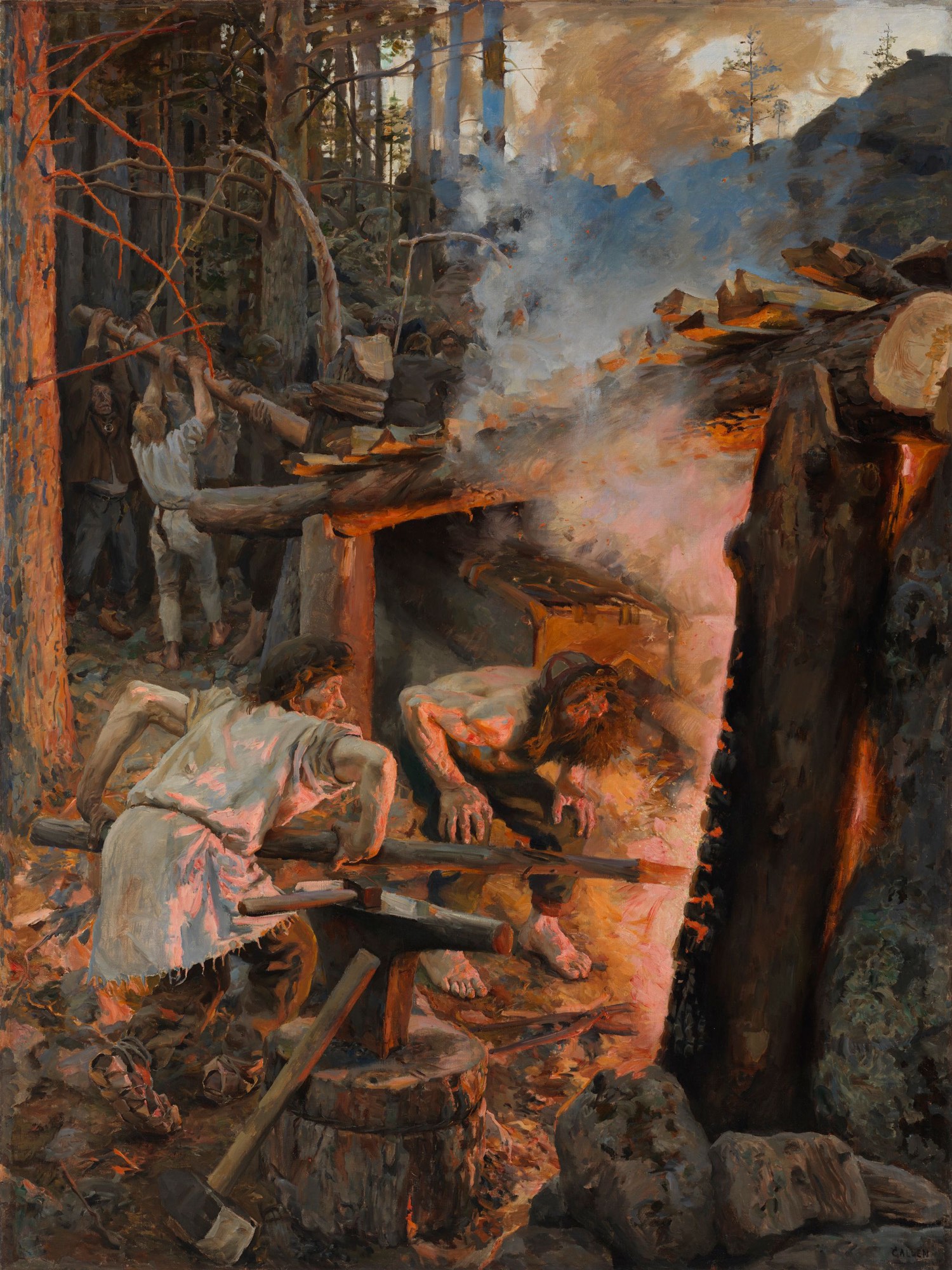
In the Kalevala
Ilmarinen is the smith whom Väinämöinen sends to Pohjola against his will, to earn the maiden of Pohjola by forging the Sampo; he forges it, but the maiden says she is not yet ready to leave her home (cantos 7 and 10). Later the maiden chooses him over Väinämöinen, and with her advice he ploughs a field of snakes, takes the bear of Tuonela and the wolf of Manala, and catches a huge pike in the river of Tuonela (cantos 18–19). His wife sets Kullervo to herd her cattle and bakes a stone into his bread, and the wolves and bears that Kullervo drives home kill her (cantos 32–33); Ilmarinen forges himself a bride of gold and silver, who stays cold (canto 37), and sings the younger sister of his first wife into a gull (canto 38). He sails with Väinämöinen and Lemminkäinen to take the Sampo (canto 39); at the end he forges a new moon and sun that will not shine, and then the tools to prise open the mountain where the mistress of Pohjola has hidden the real ones (canto 49).
Written for RunoVerse by the AI model Claude Opus 5.5 from Lönnrot's summaries of the cantos.
In the folk songs
736 songs in the archive collections name Ilmarinen. Their records place them above all in Viena Karelia, then in Ladoga Karelia, Ingria (its three regions together), North Karelia and Olonets Karelia (Aunus). About half of the Ingrian songs name him only in the line in which he strikes fire (“iski tulta ismaroinen” and similar forms), above all in the origin of fire and the laments of the fish. The song types they are filed under are led by the golden maiden, the origins of fire and of iron, and the charms of iron and of fire; next come the boat journey, the theft of the Sampo and the wooing in Hiisi.
These lines in Lönnrot's Kalevala
Kalevala, 1849, canto 37, lines 57–60
Folk song: SKVR I1 549, Uhtua, 1872
Lönnrot's Kalevala of 1849 has lines like these in canto 37; the marked words are in both texts, some in another form. This song was written down in 1872, after the Kalevala appeared.
English under the folk-song lines: translated for RunoVerse by the AI model Claude Fable 5.2. English under the Kalevala lines: W. F. Kirby, 1907.
Compare side by side · Open the song in the poem reader · Read canto 37 with Kirby's English
Lines from the folk songs
One line from the earliest record of known year at each of the ten places with the most songs. The name is marked.
- Siitä seppo Ilmarinen — SKVR I1 63 a), Vuokkiniemi, 1821
- Olkoon seppo Ilmorinen; — SKVR VII1 102, Suojärvi, 1845
- Virkki seppo Ilmarinen: — SKVR VII1 434, Ilomantsi, 1845
- "Oi sinä seppo Ilmarinen, — SKVR VII1 380, Suistamo, 1845
- Iski tulta ismerolla, — SKVR III3 3836, Narvusi, 1858
- Tuo oli seppo Ilmarinen — SKVR I1 449, Kontokki, 1820
- Itse Ilmarin isäntä, — SKVR V1 352, Lempaala, 1847
- "Oi sie seppo Ilmarinen, — SKVR I1 105, Uhtua, 1834
- Se oli seppo Ilmarinen, — SKVR I4 130, Kiimaisjärvi, 1839
- Itse Ismaro pelästyi. — SKVR III3 4033, Soikkola, 1858
Where the archive records place the songs
The places that the archive records give for the songs naming Ilmarinen.
The places with the most songs on the map: Vuokkiniemi, Suojärvi, Ilomantsi, Suistamo, Narvusi, Kontokki, Lempaala, Uhtua.
Outside the map: Brandval, Södra Finnskoga, Östmark.
- 7 or more songs
- 3 to 6 songs
- 1 or 2 songs
- (exact place not known)
All places on the map
7 or more songs
- Vuokkiniemi
- Suojärvi
- Ilomantsi
- Suistamo
- Narvusi
- Kontokki
- Lempaala
- Uhtua
- Kiimaisjärvi
- Soikkola
- Kaprio
- Tulemajärvi
- Jyskyjärvi
- Korpiselkä
- Iisalmi
- Pistojärvi
- Porajärvi
- Suomussalmi
- Pohjois-Pohjanmaa (exact place not known)
- Repola
- Säämäjärvi
- Kitee
- Impilahti
- Salmi
- Etelä-Savo (exact place not known)
- Kaavi
- Pielisjärvi
- Sakkola
3 to 6 songs
- Metsäpirtti
- Pohjois-Savo (exact place not known)
- Tyrö
- Vieljärvi
- Juva
- Kainuu (exact place not known)
- Kestilä
- Kesälahti
- Pieksämäki
- Tohmajärvi
- Viena (exact place not known)
- Joroinen
- Kiestinki
- Kontiolahti
- Serepetta
- Sotkamo
- Venjoki
- Hyrynsalmi
- Kivijärvi
- Kuusamo
- Liissilä
- Nilsiä
- Pyhäjärvi
- Rautu
- Soanlahti
- Sortavala
- Toksova
- Vuole
1 or 2 songs
- Brandval
- Eno
- Hankasalmi
- Kerimäki
- Kiihtelysvaara
- Kinnula
- Kuhmoinen
- Kuusjärvi
- Kärsämäki
- Laatokan Karjala (Raja-Karjala) (exact place not known)
- Laukaa
- Liperi
- Moloskovitsa
- Nurmes
- Paltamo
- Pielavesi
- Rautalampi
- Rautavaara
- Säyneinen
- Vihanti
- Etelä-Karjala (exact place not known)
- Haapavesi
- Hausjärvi
- Heinävesi
- Jaakkima
- Janakkala
- Junosuvanto
- Juuka
- Jäppilä
- Kangaslampi
- Kangasniemi
- Kaukola
- Keltto
- Kemijärvi
- Kiuruvesi
- Kuopio mlk
- Lapinlahti
- Lehtimäki
- Muolaa
- Muuruvesi
- Oulanka
- Oulu
- Paavola
- Parikkala
- Piippola
- Pohjois-Karjala (exact place not known)
- Pori
- Pulkkila
- Rautjärvi
- Ruskeala
- Rääkkylä
- Rääpyvä
- Saarijärvi
- Savitaipale
- Savonranta
- Simo
- Skuoritsa
- Sulkava
- Suomenniemi
- Suonenjoki
- Säkkijärvi
- Säräisniemi
- Södra Finnskoga
- Tuulos
- Tuusula
- Tyrvää
- Utajärvi
- Uukuniemi
- Uusikirkko Vpl.
- Viitasaari
- Ylikiiminki
- Östmark
The name as the singers said it
The forms of the name that the collectors wrote down from the singers, each found in at least three songs. Spellings that differ only in writing are joined, and forms with a case ending, such as Ilmarisen, are left out. Under each form: the number of songs, and the region where more than half of them were recorded.
More Kalevala art
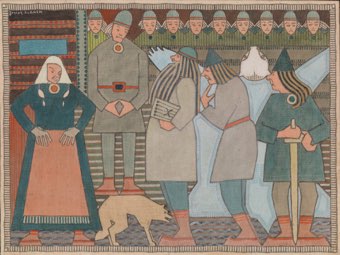
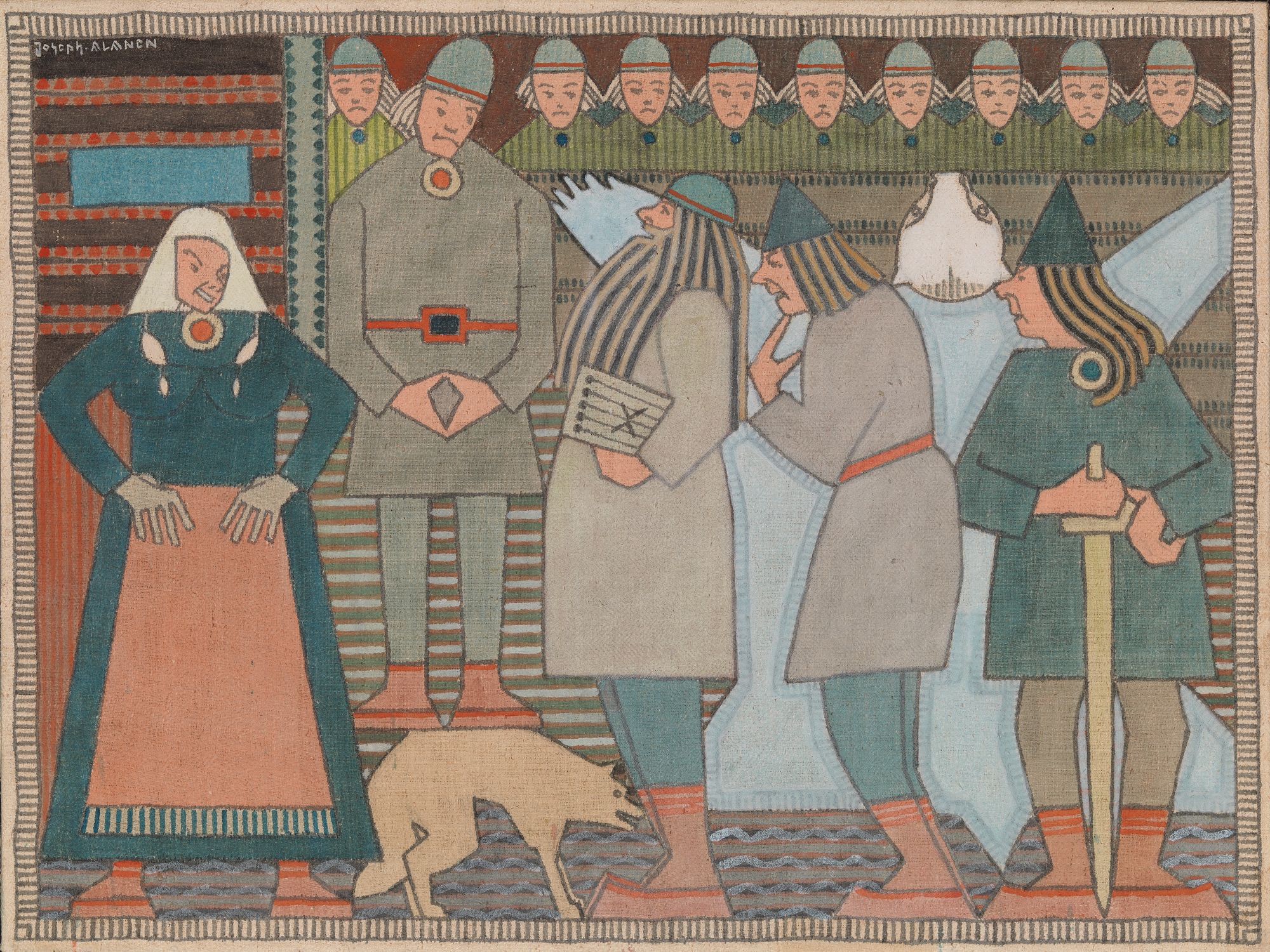
Väinämöinen, Ilmarinen and Lemminkäinen Arrive in Pohjola Canto 42 · Lines 1–58Väinämöisen, Ilmarisen ja Lemminkäisen tulo Pohjolaan (Väinämöinen, Ilmarinen and Lemminkäinen Arrive in Pohjola). Joseph Alanen, undated. Read the scene: The three heroes arrive in Pohjola, canto 42, lines 1–58 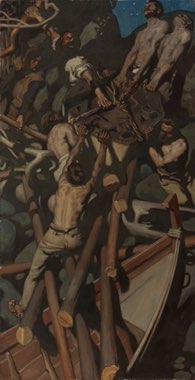
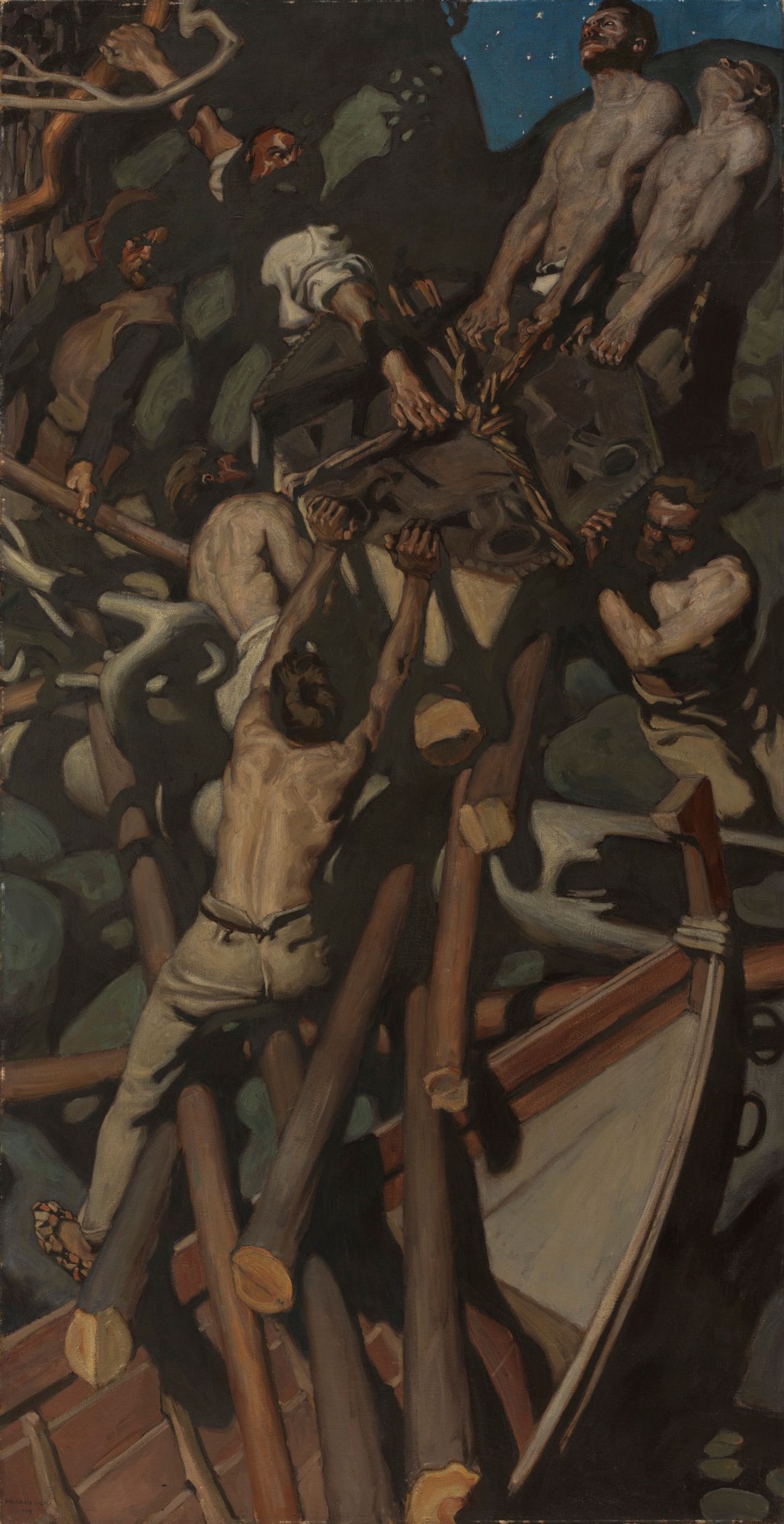
The Theft of the Sampo Canto 42 · Lines 65–164Sammon ryöstö (The Theft of the Sampo). Akseli Gallen-Kallela, 1905. Read the scene: The heroes take the Sampo out of the stone mountain, canto 42, lines 65–164 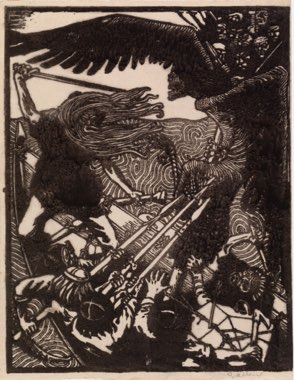
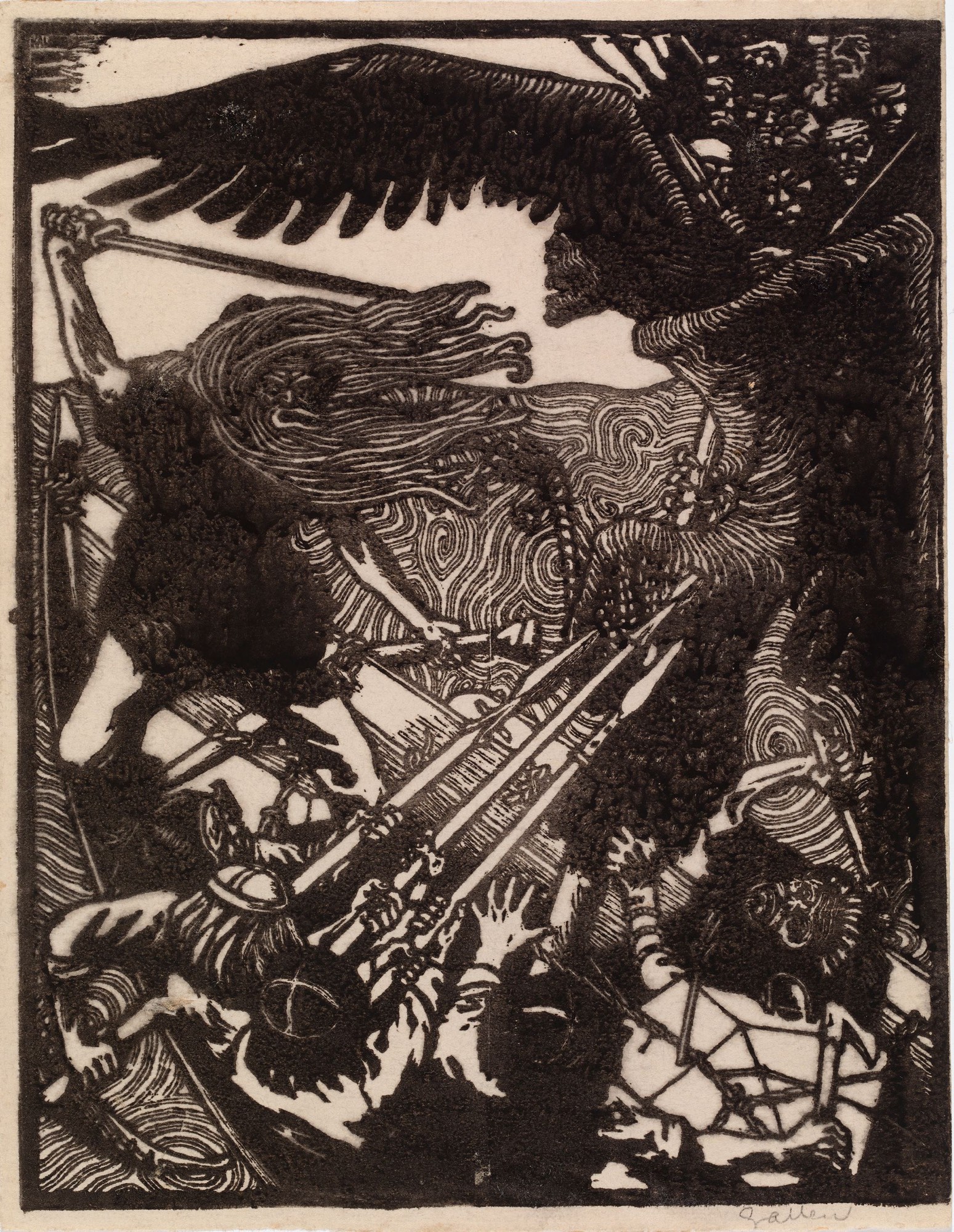
Defence of the Sampo Canto 43 · Lines 23–258Sammon puolustus (Defence of the Sampo). Akseli Gallen-Kallela, 1895. Read the scene: The mistress of Pohjola attacks the raiders of the Sampo at sea, canto 43, lines 23–258
Song types (SKVR and ERAB songs; JR records carry none)
Kultaneito, Tulen synty, Raudan synty, Raudan sanat, Tulen sanat, Laivaretki, Sammon ryöstö, Hiidestä kosinta, Kanteleen soitto, Kanteleen synty, Sammon taonta, Kilpakosinta
The full list, with the number of songs, is under Counts.
The cantos where Ilmarinen appears
- Canto 7
Väinämöinen swims for several days on the open sea. The eagle, grateful to him for having spared the birch-tree for him to rest on, when he was felling the trees takes Väinämöinen on his wings, and carries him to the borders of Pohjola, where the Mistress of Pohjola takes him to her abode, and receives him hospitably. Väinämöinen desires to return to his own country, and the Mistress of Pohjola permits him to depart, and promises him her daughter in marriage if he will forge the Sampo in Pohjola. Väinämöinen promises that when he returns home he will send the smith Ilmarinen to forge the Sampo, and the Mistress of Pohjola gives him a horse and a sledge to convey him home.
- Canto 9
Väinämöinen repeats to the old man the legend of the origin of iron. The old man reviles the iron and repeats spells for the stopping of blood, and the flow of blood is stayed. The old man directs his son to prepare a salve, and dresses and binds up the wound. Väinämöinen is cured, and thanks Jumala for his merciful assistance.
- Canto 10
Väinämöinen reaches home and urges Ilmarinen to depart to woo the Maiden of Pohja, because he would be able to forge a Sampo. Ilmarinen refuses to go to Pohjola, but Väinämöinen conveys him thither without his consent by a stratagem. Ilmarinen arrives in Pohjola, where he is very well received, and promises to forge a Sampo. He forges the Sampo, and the Mistress of Pohjola conceals it in the Rocky Mountain of Pohjola. Ilmarinen asks for the maiden as his reward, but she makes excuses, saying that she is not yet ready to leave home. Ilmarinen receives a boat, returns home, and informs Väinämöinen that he has forged the Sampo in Pohjola.
- Canto 15
One day blood begins to trickle from the hair-brush at Lemminkainen's home, and his mother at once perceives that death has overtaken her son. She hastens to Pohjola and inquires of Louhi what has become of him. The Mistress of Pohjola at length tells her on what errand she has sent him, and the sun gives her full information of the manner of Lemminkainen's death. Lemminkainen's mother goes with a long rake in her hand under the cataract of Tuoni, and rakes the water till she has found all the fragments of her son's body, which she joins together, and succeeds in restoring Lemminkainen to life by charms and magic salves. Lemminkainen then relates how he perished in the river of Tuonela, and returns home with his mother.
- Canto 17
Väinämöinen goes to obtain magic words from Antero Vipunen, and wakes him from his long sleep under the earth. Vipunen swallows Väinämöinen, and the latter begins to torture him violently in his stomach. Vipunen tries every means that he can think of to get rid of him by promises, spells, conjurations and exorcisms, but Väinämöinen declares that he will never depart till he has obtained from Vipunen the words which he requires to finish his boat. Vipunen sings all his wisdom to Väinämöinen, who then leaves his body, returns to his boat-building, and finishes his boat.
- Canto 18
Väinämöinen sets sail in his new boat to woo the Maiden of Pohja. Ilmarinen's sister sees him, calls to him from the shore, learns the object of his journey, and hastens to warn her brother that a rival has set forth to Pohjola to claim the bride. Ilmarinen makes ready, and rides on horseback to Pohjola along the shore. The Mistress of Pohjola sees the suitors approaching, and advises her daughter to choose Väinämöinen. But the daughter herself prefers Ilmarinen, the forger of the Sampo, and tells Väinämöinen, who is first to arrive, that she will not marry him.
- Canto 19
Ilmarinen arrives at the homestead of Pohjola, woos the daughter of the house, and perilous tasks are assigned to him. Aided by the advice of the Maiden of Pohja he succeeds in performing the tasks successfully. Firstly, he ploughs a field of serpent, secondly, he captures the Bear of Tuoni and the Wolf of Manala, and thirdly, he captures a large and terrible pike in the river of Tuonela. The Mistress of Pohjola promises and betroths her daughter to Ilmarinen. Väinämöinen returns from Pohjola in low spirits, and warns every one against going wooing in company with a younger man.
- Canto 22
The bride is prepared for her journey and is reminded of her past life and of the altered life that now lies before her. She becomes very sorrowful. They bring her to weeping. She weeps. They comfort her.
- Canto 24
The bridegroom is instructed how he should behave towards his bride, and is cautioned not to treat her badly. An old beggar relates how he once brought his wife to reason. The bride remembers with tears that she is now quitting her dear birthplace for the rest of her life, and says farewell to all. Ilmarinen lifts his bride into the sledge and reaches his home on the evening of the third day.
- Canto 25
The bride, the bridegroom and their company are received at the home of Ilmarinen. The company are hospitably entertained with food and drink: and Väinämöinen sings the praises of the host, the hostess, the inviter, the bridesmaid, and the other wedding-guests. On the way back Väinämöinen's sledge breaks down, but he repairs it, and drives home.
- Canto 30
Lemminkainen goes to ask his former comrade-in-arms, Tiera, to join him in an expedition against Pohjola. The Mistress of Pohjola sends the Frost against them, who freezes the boat in the sea, and almost freezes the heroes themselves in the boat, but that Lemminkainen restrains it by powerful charms and invocations. Lemminkainen and his companion walk across the ice to the shore, wander about in the waste for a long time in a miserable plight, and at last make their way home.
- Canto 31
Untamo wages war against his brother Kalervo, overthrows Kalervo and his army, sparing only a single pregnant woman of the whole clan. She is carried away to Untamo's people, and gives birth to her son Kullervo. Kullervo resolves in his cradle to take revenge on Untamo, and Untamo attempts several times to put him to death, but without success. When Kullervo grows up, he spoils all his work, and therefore Untamo sells him as a slave to Ilmarinen.
- Canto 32
The wife of Ilmarinen makes Kullervo her herdsman and maliciously bakes him a stone in his lunch. She then sends him out with the cattle, after using the usual prayers and charms for their protection from bears in the pastures.
- Canto 33
While Kullervo is in the pasture in the afternoon he tries to cut the cake with his knife which he completely spoils, and this goes to his heart the more because the knife was the only remembrance left to him of his family. To revenge himself on the mistress, he drives the cattle into the marshes to be devoured by beasts of the forest, and gathers together a herd of wolves and bears, which he drives home in the evening. When the mistress goes to milk them she is torn to pieces by the wild beasts.
- Canto 34
Kullervo escapes from the homestead of Ilmarinen, and wanders sorrowfully through the forest, where he meets with the Old Woman of the Forest, who informs him that his father, mother, brothers and sisters are still living. Following her directions he finds them on the borders of Lapland. His mother tells him that she had long supposed him to be dead, and also that her elder daughter had been lost when gathering berries.
- Canto 37
Ilmarinen weeps long for his dead wife and then forges himself a wife of gold and silver with great labour and trouble. At night he rests by the golden bride, but finds in the morning that the side which he has turned towards her is quite cold. He offers his golden bride to Väinämöinen, who declines to receive her, and advises him to forge more useful things, or to send her to other countries where people wish for gold.
- Canto 38
Ilmarinen goes to Pohjola to woo the younger sister of his first wife, but as he receives only insulting words in reply, he becomes angry, seizes the maiden, and starts on his homeward journey. On the way the maiden treats Ilmarinen with contempt, and provokes him till he changes her into a seagull. When Ilmarinen comes home, he relates to Väinämöinen how the inhabitants of Pohjola live free from care since they possessed the Sampo; and also tells him how badly his wooing has prospered.
- Canto 39
Väinämöinen persuades Ilmarinen to go with him to Pohjola to bring away the Sampo. Ilmarinen consents, and the heroes start off on their journey in a boat. Lemminkainen hails them from the shore, and on hearing where they are going, proposes to join them, and is accepted as a third comrade.
- Canto 40
The Sampo-raiders come to a waterfall, beneath which the boat is caught fast on the back of a great pike. The pike is killed, and the front part is taken into the boat, cooked, and eaten. Väinämöinen makes the jaws of the pike into a kantele, on which several of the party attempt to play, but without success.
- Canto 42
The heroes arrive at Pohjola, and Väinämöinen announces that he has come to take possession of the Sampo, either with good-will, or by force. The Mistress of Pohjola refuses to yield it either by consent or by compulsion, and calls together her people to oppose him. Väinämöinen takes the kantele, begins to play, and lulls to sleep all the people of Pohjola, and goes with his companions to search for the Sampo; they take it from the stone mountain and convey it to the boat. They sail homewards well satisfied, carrying the Sampo with them. On the third day the Mistress of Pohjola wakes from her sleep, and when she finds that the Sampo has been carried off, she prepares a thick fog, a strong wind, and other impediments, to oppose the robbers of the Sampo, which reach the vessel, and during the tempest Väinämöinen's kantele falls into the water.
- Canto 43
The Mistress of Pohjola equips a war-vessel and goes in pursuit of the robbers of the Sampo. When she overtakes them a fight ensues between the forces of Pohjola and Kalevala in which the latter conquer. Nevertheless the Mistress of Pohjola succeeds in dragging the Sampo from the boat into the lake, where it breaks to pieces. The larger portions sink in the lake, and form its riches, while the smaller pieces are thrown on shore by the waves, at which Väinämöinen is much pleased. The Mistress of Pohjola threatens to send all evil upon Kalevala, to which Väinämöinen pays no attention. The Mistress of Pohjola returns home in great distress, taking with her only a small fragment of the cover of the Sampo. Väinämöinen carefully collects the fragments of the Sampo on the shore, and plants them, hoping for continuous good fortune.
- Canto 44
Väinämöinen goes to seek for his kantele which was lost in the lake, but cannot find it. He makes himself a new kantele of birchwood, on which he plays, and delights every creature in the neighbourhood.
- Canto 46
The Mistress of Pohjola sends a bear to destroy the herds of Kalevala. Väinämöinen kills the bear, and a great feast is held in Kalevala in honour of the occasion. Väinämöinen sings, plays on the kantele, and hopes that a time of great happiness and prosperity is coming to Kalevala.
- Canto 47
The moon and sun descend to listen to Väinämöinen's playing. The Mistress of Pohjola succeeds in capturing them, hides them in a mountain, and steals the fire from the homes of Kalevala. Ukko, the Supreme God, is surprised at the darkness in the sky, and kindles fire for a new moon and a new sun. The fire falls to the ground, and Väinämöinen and Ilmarinen go to search for it. The Virgin of the Air informs them that the fire has fallen into Lake Alue, and has been swallowed by a fish. Väinämöinen and Ilmarinen try to catch the fish with a net of bast, but without success.
- Canto 48
The heroes prepare a linen net, and at length capture the fish which has swallowed the fire. The fire is found in the fish's belly, but flashes up suddenly, and burns Ilmarinen's cheeks and hands severely. The fire rushes into the forest, burns over many countries, and spreads further and further, till at length it is captured and carried to the dark dwellings of Kalevala. Ilmarinen recovers from his burns.
- Canto 49
Ilmarinen forges a new moon and sun but cannot make them shine. Väinämöinen discovers by divination that the moon and sun are hidden in the mountain of Pohjola, goes to Pohjola and conquers the whole nation. He sees the moon and sun in the mountain, but cannot enter. He returns home to procure tools with which to break open the mountain. While Ilmarinen is forging them, the Mistress of Pohjola, fearing that it may go ill with her, releases the moon and sun. When Väinämöinen sees the moon and sun reappear in the sky, he salutes them, hoping that they will always go brightly on their course, and bring happiness to the country.
Summaries: W. F. Kirby, 1907, from Lönnrot's summaries in the 1849 edition.
Counts
Songs naming Ilmarinen: 736.
By collection: SKVR 606; JR 130.
Regions, with the number of songs (a region counts every song from any of its places once): Viena 171, Laatokan Karjala (Raja-Karjala) 117, Pohjois-Karjala 103, Aunus 72, Länsi-Inkeri 44, Keski-Inkeri 34, Etelä-Savo 31, Kainuu 29, Itä- ja Pohjois-Inkeri 28, Pohjois-Savo 27, Pohjois-Pohjanmaa 25, Etelä-Karjala 24, Keski-Suomi 13, Häme 4, Metsäsuomalaisten alue 4, Peräpohjola 2, Satakunta 2, Etelä-Pohjanmaa 1, Länsipohja 1, Uusimaa 1.
Places on the map, with the number of songs (a song given two places counts at both): Vuokkiniemi 94, Suojärvi 50, Ilomantsi 49, Suistamo 29, Narvusi 28, Kontokki 24, Lempaala 20, Uhtua 20, Kiimaisjärvi 19, Soikkola 16, Kaprio 14, Tulemajärvi 14, Jyskyjärvi 12, Korpiselkä 12, Iisalmi 11, Pistojärvi 11, Porajärvi 11, Suomussalmi 11, Pohjois-Pohjanmaa 10, Repola 10, Säämäjärvi 10, Kitee 9, Impilahti 8, Salmi 8, Etelä-Savo 7, Kaavi 7, Pielisjärvi 7, Sakkola 7, Metsäpirtti 6, Pohjois-Savo 6, Tyrö 6, Vieljärvi 6, Juva 5, Kainuu 5, Kestilä 5, Kesälahti 5, Pieksämäki 5, Tohmajärvi 5, Viena 5, Joroinen 4, Kiestinki 4, Kontiolahti 4, Serepetta 4, Sotkamo 4, Venjoki 4, Hyrynsalmi 3, Kivijärvi 3, Kuusamo 3, Liissilä 3, Nilsiä 3, Pyhäjärvi 3, Rautu 3, Soanlahti 3, Sortavala 3, Toksova 3, Vuole 3, Brandval 2, Eno 2, Hankasalmi 2, Kerimäki 2, Kiihtelysvaara 2, Kinnula 2, Kuhmoinen 2, Kuusjärvi 2, Kärsämäki 2, Laatokan Karjala (Raja-Karjala) 2, Laukaa 2, Liperi 2, Moloskovitsa 2, Nurmes 2, Paltamo 2, Pielavesi 2, Rautalampi 2, Rautavaara 2, Säyneinen 2, Vihanti 2, Etelä-Karjala 1, Haapavesi 1, Hausjärvi 1, Heinävesi 1, Jaakkima 1, Janakkala 1, Junosuvanto 1, Juuka 1, Jäppilä 1, Kangaslampi 1, Kangasniemi 1, Kaukola 1, Keltto 1, Kemijärvi 1, Kiuruvesi 1, Kuopio mlk 1, Lapinlahti 1, Lehtimäki 1, Muolaa 1, Muuruvesi 1, Oulanka 1, Oulu 1, Paavola 1, Parikkala 1, Piippola 1, Pohjois-Karjala 1, Pori 1, Pulkkila 1, Rautjärvi 1, Ruskeala 1, Rääkkylä 1, Rääpyvä 1, Saarijärvi 1, Savitaipale 1, Savonranta 1, Simo 1, Skuoritsa 1, Sulkava 1, Suomenniemi 1, Suonenjoki 1, Säkkijärvi 1, Säräisniemi 1, Södra Finnskoga 1, Tuulos 1, Tuusula 1, Tyrvää 1, Utajärvi 1, Uukuniemi 1, Uusikirkko Vpl. 1, Viitasaari 1, Ylikiiminki 1, Östmark 1.
Songs whose record gives no place that can be put on the map: 4.
The ten places with the most songs account for 349 of the 732 songs that have a place on the map (48%).
SKVR and ERAB songs without a song type: 2 of 606 (0%).
Song types, with the number of songs: Kultaneito 102, Tulen synty 95, Raudan synty 93, Raudan sanat 89, Tulen sanat 74, Laivaretki 62, Sammon ryöstö 62, Hiidestä kosinta 61, Kanteleen soitto 56, Kanteleen synty 56, Sammon taonta 55, Kilpakosinta 53, Väinämöisen ammunta 48, Verensulku 42, Maailmansyntyruno 40, Iro-neito 36, Veneenveisto 33, Taivaan taonta 27, Kalojen valituksia 22, Ilmarisen takominen 20, Polvenhaava 20, Vieraalle maalle joutunut 19, Vipusen virsi 19, Pistoksen synty 16, Pistos 16, Purren itku 15, Kilpalaulanta 14, Nurmen neito 14, Iivana Kojosenpoika 13, Lemminkäisen virsi 11, Kalevanpojan kosto 9, Iski tulta Ilmarinta 8, Inkerin virsi 7, Koskelta kosinta 7, Vellamon neidon onginta 7, Hiiden sepän kahlinta 6, Marjavirsi 6, Rutsa 6, Voiteen synty 6, Vuoresta veden synty 6, Avunpyyntö 5, Jänis neuvoi poikiansa 5, Kyynelten vierintä 5, Polin puulle pyörivälle 5, Tuonelassa käynti 5, Ylösnousemusvirsi 5, Ahdin ja Kyllikin runo 4, Ennen naidun naisen tappo 4, Herhiläisen tai mehiläisen synty 4, Hääväki varataan 4, Iso tammi 4, Kullasta saari 4, Laivassa surmattu veli 4, Laulajan alkusanoja 4, Meren neito, metsän sulho 4, Parempi on omalla maalla ropehesta vettä juoda 4, Saaren neidot 4, Saunanhakuvirsi 4, Taivaanvalojen kosinta 4, Vesi vanhin veljeksistä 4, Ilmarinen kengitti hevosta 3, Kullervon sotaanlähtö 3, Lapsenetsintävirsi 3, Saaresta kosinta 3, Tuuterin tuhmat miehet 3, Annikaisen virsi 2, Aukaisen sanaisen arkun 2, Erilaisia parannusloitsuja 2, Hiiden hirven hiihdäntä 2, Ihmehevonen 2, Ihmetupa 2, Ihmisen synty 2, Iivanan virsi 2, Kalervo ja Untamo 2, Kehoitus laulamaan 2, Kiskoin kivestä tuohta 2, Kultapyörätammi 2, Käärmeen sanat 2, Käärmeen synty 2, Käärmetuoppi 2, Lapsen itkettäjä 2, Lauri Lappalainen 2, Lemmennostoloitsut 2, Mahtuuko vävy tupaan? 2, Mataleenan virsi 2, Mereen silta yksiöisistä vesoista 2, Muut naivat paremmat naiset 2, Neitoa kositaan eri paikkoihin 2, Oikein on otavat tehty 2, Oli meitä ennen paljon 2, Pilvilampi 2, Puun synty 2, Päivän päästö 2, Päänpesu porolla ja lipeällä 2, Sepäksi neuvottu 2, Suka mereen 2, Syöttäkää, juottakaa, viekää suojaan vävyn hevonen 2, Ulkoa runoja kuulin 2, Voiteen luku 2, Väinämöisen tuomio 2, Vävyn virsi 2, Ammus 1, Ampiaisen nostatus 1, Anna itkeä itikan 1, Ei ne laula kaikki lapset 1, En mä elä elotta, asu ilman ammatitta 1, Ennen metsä puita puuttuu 1, Haittan' on hako vesillä, köyhät eellä rikkahalla 1, Hammastauti 1, Hekon runo 1, Huorat huuhtoi huntujaan 1, Ilmanimmen kosinta 1, Iske tulta Ilmarinen 1, Iso hauki 1, Isälle ja vieraalle jauhaminen, soutaminen 1, Jaakko Pontus 1, Joka puu puree, joka sammakko sanoo 1, Kaatumatauti 1, Kateen sanat 1, Kateita ja noitia vastaan 1, Kaukamoisen virsi 1, Keihään synty 1, Kerskaukset ja varaukset 1, Kommilta kosinta 1, Korpin synty 1, Koskea laskiessa 1, Kukku siulla, kukku miulla 1, Kun ei jäät jänistä kanna 1, Käärmeen pureman parantaminen eläimestä 1, Lapista, Turjan maalta, lintu, yksi siipi vettä viisti 1, Laula, laula, kieli keito 1, Laulajan kerskauksia 1, Laulajan lopetussanoja 1, Laulajan palkka 1, Laulanta runolla työnä - kukunta käellä 1, Lunastettava neito 1, Lupa koiran luuta purra, hirven hankia hypätä 1, Löylyn luku 1, Marketan runo 1, Meren kosijat 1, Metsien lunastaja Ismaroinen 1, Metsälle lähtiessä 1, Miehen kolme pahaa 1, Miekan tai keihään kuvaus 1, Miksi on utuinen ilma 1, Minäpä luotan Luojahani 1, Mitä istut isännän poika 1, Niukahduksen historiola 1, Niukahdus 1, Noidannuolten synty 1, Nuotan synty 1, Näin ennen eukko, isä lauloi 1, Olin orjana Virossa 1, Oluen synty 1, Oluen uhkaus 1, Oreskan Ievan vaatteet 1, Paimenen virsi 1, Paise 1, Paiseen synty 1, Pakkasen sanat 1, Pakkasen synty 1, Puun sanat 1, Päivänmakaajaksi pilatun lehmän parantaminen 1, Rikkaan raha kuluu, köyhän raiskan pää menee 1, Rikoilla kuuntelija 1, Sian synty 1, Sota Narvan tienoilla 1, Souda laiva Suomeen 1, Syntymistään sureva 1, Syöpä 1, Syövän synty 1, Sämpsä Pellervoinen 1, Tartunta 1, Tautien synty 1, Torajoelle riitelemään 1, Tule tehdyille teloille 1, Tuli ukko Turjan maalta 1, Tuon ilon tullessani 1, Tuonelta kosinta 1, Tuulen nosto 1, Täss on vanha virrenseppä 1, Ukko ruski, taivas paukku minun hoikan huoliani 1, Ukkosen sanat 1, Ukonilmalla 1, Varjele, vakaini Luoja 1, Venepuun etsintä 1, Vesitiellä viipynyt 1, Virret vilussa - pahassa paikassa 1, Väinämöisen kielto 1.
Spellings of the name, with the number of songs: ilmarinen 271, ilmarisen 75, ilmolline 56, ilmollini 45, ilmarin 42, ilmollinen 42, ilmarinta 31, ilmorini 29, ilmorinen 23, ilmorisen 21, ilmarine 18, ismaroi 17, ilimarinen 16, ilmari 16, ilmarini 16, ismaroin 16, ilmorine 11, ilmollisen 10, ilmorin 9, ismaro 8, ismarolla 7, ilmariselle 6, ismaroinen 6, ilmarille 5, ismaroine 5, illmarinen 4, ilmallisen 4, ilmarisella 4, ilmaroinen 4, ilemarinen 3, ilmalline 3, ilmarista 3, ilmaroi 3, ilmoline 3, ilmoriine 3, ilimar 2, ilimarin 2, ilmahinen 2, ilmallinen 2, ilmallizele 2, ilmallizen 2, ilmaria 2, ilmarinnan 2, ilmaro 2, ilmollisel 2, ilmollizel 2, ilmori 2, ilmoriini 2, ilmorisella 2, ilmoriselle 2, ismaroille 2, ismarolle 2, ilemar 1, ilemarisen 1, ilimarim 1, ilimarisen 1, illmarin 1, illmori 1, ilmahisen 1, ilmalizele 1, ilmalizen 1, ilmallizel 1, ilmarainen 1, ilmareselle 1, ilmariis 1, ilmarilla 1, ilmarim 1, ilmarinisosen 1, ilmarinki 1, ilmarinne 1, ilmariseii 1, ilmarizen 1, ilmaroin 1, ilmaroisen 1, ilmaroita 1, ilmarunen 1, ilmeroine 1, ilmeröinen 1, ilmeröllä 1, ilmeröönen 1, ilmolinen 1, ilmolisen 1, ilmolizen 1, ilmolliin 1, ilmollin 1, ilmollinego 1, ilmollinigo 1, ilmollinj 1, ilmollinji 1, ilmollisell 1, ilmolliselle 1, ilmollizen 1, ilmoran 1, ilmorinnon 1, ilmorinta 1, ilmorisill 1, ilmorista 1, ilmorriini 1, ilmorrinnon 1, imaroinen 1, ismaroll 1, ismarolta 1, ismarone 1, ismaroni 1, ismerolla 1, izmaroi 1, izmaroine 1, izmarolla 1.
Not counted: texts an editor reworked or put together, lines quoted in early scholars' books and papers, texts from early anthologies, poems the archive's editors doubted were folk poetry, composed poems, and texts learned from the Kalevala or other print: EKmS 4° 3, 515/8 (1), EKmS 4° 5, 60 (142), H II 24, 281/2 (43), H II 26, 129 (21), H II 39, 523/44 (577), H III 22, 601/3, H, Mapp 1179, H, Mapp 31/6, JR 02316, JR 02471, JR 02556, JR 03086, JR 03371, JR 21812, JR 25002, JR 25029, JR 25115, JR 28268, JR 38413, JR 47299, JR 48206, JR 50822, JR 80696, JR 81714, JR 84531, JR 84532, JR 84545, JR 84602, JR 84627, JR 85375, JR 85401, JR 85466, JR 85491, JR 85509, SKVR VI2 liite III 4, SKVR XII1 4069, SKVR XII1 4071, SKVR XII1 4073, SKVR XII1 4196, SKVR XII1 4488, SKVR XII1 4492, SKVR XII1 4650, SKVR XII2 5239, SKVR XII2 5258, SKVR XII2 5259, SKVR XII2 6114, SKVR XII2 8010, SKVR XII2 8011, SKVR XII2 8013, SKVR XV 211, SKVR XV 231, SKVR XV 238, SKVR XV 248, SKVR XV 250, SKVR XV 316, SKVR XV 60, SKVR XV 65, SKVR XV 67, SKVR XV 69, SKVR XV 70.
Not counted a second time: 130 texts that copy a record held elsewhere in the collections (fair copies, copies among another collector's papers, excerpts printed separately).
About this page
A song counts on this page when it names Ilmarinen, in any spelling. A song counts once, however often the name occurs in it. The numbers say how many songs name the figure, not how many songs are about it.
The songs are the folk songs in RunoVerse from the SKVR and JR collections of the Finnish Literature Society and from the Estonian Folklore Archives (ERAB). Literary texts are left out: Lönnrot's Kalevala and its earlier versions, the Kanteletar and the other works of the KR corpus. So are songs that the archive files as learned from the Kalevala, and texts that turned out on reading to be an editor's reworking or compilation, lines quoted in early scholars' books and papers, texts from early anthologies, poems the archive's editors doubted were folk poetry, composed poems or texts learned from print, or to follow the printed Kalevala line by line; they are listed under Counts. An early print that is the only surviving record of a song is counted, and so are songs in which the archive's editors saw only some influence of print. When the collections hold one record twice, as a fair copy, as a copy among another collector's papers or as an excerpt printed separately, it counts once.
Each spelling of the name was sorted. Spellings that can only be the name count as they stand. Spellings that are also ordinary words or other names (aino 'only', for instance, or Ahti, also the name of a water god) were decided line by line, each line read in its song. The sorting and the line decisions were made by the AI model Claude Opus 5.5.
The places are those the archive records give: usually the place where the song was written down, for some songs the singer's home parish. A dashed circle marks a region named without a more exact place. A song given two places counts at both.
The cantos are those of Lönnrot's Kalevala of 1849 in which the figure is named. Under each canto is W. F. Kirby's summary of 1907.