Väinämöinen in the Kalevala and the folk songs
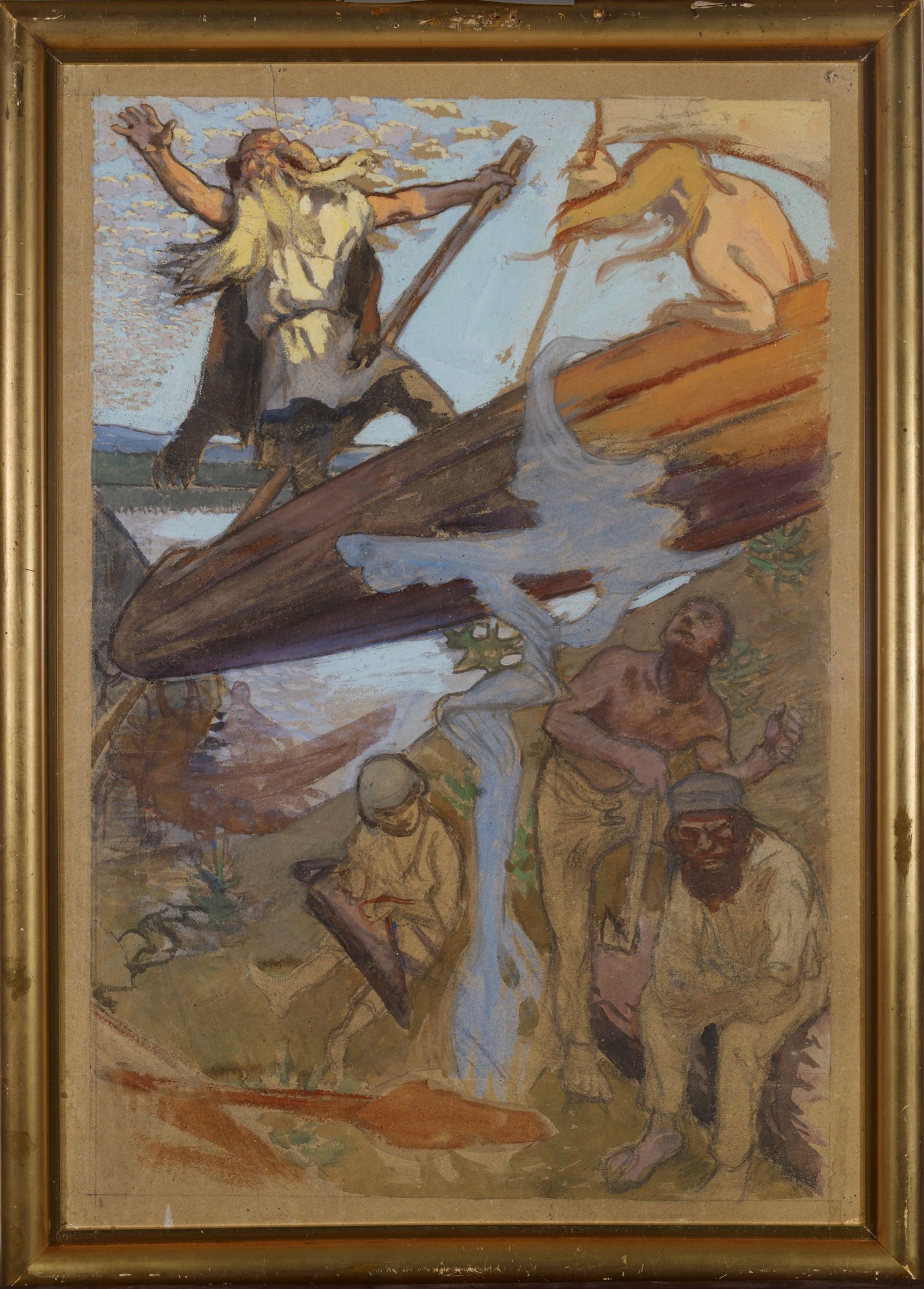
In the Kalevala
Väinämöinen is born of the maiden of the air, who has come down into the sea and become the mother of the water; he drifts long on the waves before he comes ashore on a treeless land, where Sampsa Pellervoinen sows the trees and Väinämöinen himself the barley (cantos 1–2). He sings Joukahainen into a bog, and Joukahainen promises him his sister, who will not marry an old man and drowns while bathing; Väinämöinen catches her on his hook in the shape of a fish, but she slips back into the sea (cantos 3–5). He builds a boat, seeking the words he lacks in Tuonela and finding them in the belly of Antero Vipunen, and sails in it to woo the maiden of Pohjola, but she chooses the smith Ilmarinen (cantos 16–18). He makes a kantele from a pike's jawbone and moves every living thing to tears with it (cantos 40–41), leads the raid that takes the Sampo from Pohjola (cantos 42–43), and at the end, rebuked by Marjatta's son, departs in a copper boat, leaving his kantele and his great songs to the people (canto 50).
Written for RunoVerse by the AI model Claude Opus 5.5 from Lönnrot's summaries of the cantos.
In the folk songs
2,289 songs in the archive collections name Väinämöinen. Their records place them above all in Viena Karelia, then in Ladoga Karelia, North Karelia and Olonets Karelia (Aunus); of single places, Vuokkiniemi has the most. The song types they are filed under are led by the wounded knee, the origin and the charms of fire, the playing of the kantele, the singing contest and the boat journey.
These lines in Lönnrot's Kalevala
Kalevala, 1849, canto 16, lines 101–104
Folk song: SKVR II 160, Repola, 1872
Lönnrot's Kalevala of 1849 has lines like these in canto 16; the marked words are in both texts, some in another form. This song was written down in 1872, after the Kalevala appeared.
English under the folk-song lines: translated for RunoVerse by the AI model Claude Fable 5.2. English under the Kalevala lines: W. F. Kirby, 1907.
Compare side by side · Open the song in the poem reader · Read canto 16 with Kirby's English
Lines from the folk songs
One line from the earliest record of known year at each of the ten places with the most songs. The name is marked.
- Se on vanha Väinämöinen, — SKVR I1 403, Vuokkiniemi, 1821
- Päälle vanhan Väinämöisen. — SKVR VII1 14, Suistamo, 1845
- Tuo oli vanha Väinämöinen, — SKVR I1 158, Kontokki, 1820
- Soitti vanha Väinämöinen, — SKVR VII1 607, Ilomantsi, 1828
- Älä kutschu vanhoaa Väinämöistä. — SKVR I2 826, Uhtua, 1825
- Olkoon vanha Väinämöinen; — SKVR VII1 102, Suojärvi, 1845
- Vyöllä vanhan Väinämöisen, — SKVR I4 130, Kiimaisjärvi, 1839
- Virkki vanha Väinämöinen: — SKVR II 173, Repola, 1845
- Olkah vanha Väinämöinen; — SKVR VII1 100, Korpiselkä, 1846
- Tuop' oli viekas Väinämöini — SKVR I1 134, Pistojärvi, 1872
Where the archive records place the songs
The places that the archive records give for the songs naming Väinämöinen.
The places with the most songs on the map: Vuokkiniemi, Suistamo, Kontokki, Ilomantsi, Uhtua, Suojärvi, Kiimaisjärvi, Repola.
Outside the map: Östmark, Brandval, Grue Finnskog, Lekvattnet, Metsäsuomalaisten alue, Säfsnäs, Södra Finnskoga.
- 7 or more songs
- 3 to 6 songs
- 1 or 2 songs
- (exact place not known)
All places on the map
7 or more songs
- Vuokkiniemi
- Suistamo
- Kontokki
- Ilomantsi
- Uhtua
- Suojärvi
- Kiimaisjärvi
- Repola
- Korpiselkä
- Pistojärvi
- Suomussalmi
- Jyskyjärvi
- Sotkamo
- Kitee
- Soikkola
- Lempaala
- Porajärvi
- Viena (exact place not known)
- Kivijärvi
- Kaprio
- Nurmes
- Sakkola
- Etelä-Savo (exact place not known)
- Tulemajärvi
- Impilahti
- Narvusi
- Kesälahti
- Kittilä
- Juva
- Kaavi
- Pohjois-Pohjanmaa (exact place not known)
- Viitasaari
- Kainuu (exact place not known)
- Kestilä
- Pielavesi
- Pielisjärvi
- Soanlahti
- Rautalampi
- Saarijärvi
- Säämäjärvi
- Kiestinki
- Pieksämäki
- Vuole
- Hyrynsalmi
- Iisalmi
- Joroinen
- Juuka
- Rääkkylä
- Salmi
- Kiuruvesi
- Muuruvesi
- Tohmajärvi
- Valtimo
- Vieljärvi
- Kärsämäki
- Parikkala
- Sortavala
- Toksova
- Kuhmo
- Paltamo
- Pohjois-Karjala (exact place not known)
- Pulkkila
- Reisjärvi
3 to 6 songs
- Ilmajoki
- Jaakkima
- Kerimäki
- Kiihtelysvaara
- Kuusamo
- Lappajärvi
- Metsäpirtti
- Pihtipudas
- Pudasjärvi
- Rautavaara
- Säräisniemi
- Karstula
- Kemi
- Kinnula
- Kontiolahti
- Piippola
- Ristijärvi
- Sonkajärvi
- Suonenjoki
- Tyrö
- Uukuniemi
- Etelä-Karjala (exact place not known)
- Haapajärvi
- Hankasalmi
- Kurkijoki
- Lapinlahti
- Liperi
- Nilsiä
- Paatene
- Pyhäjärvi
- Pyhäntä
- Savitaipale
- Savonranta
- Taivalkoski
- Tuupovaara
- Varpaisjärvi
- Hiitola
- Karttula
- Köyliö
- Laukaa
- Lemi
- Maaninka
- Moloskovitsa
- Multia
- Muonio
- Mäntyharju
- Pohjois-Savo (exact place not known)
- Pyhäjärvi Ol.
- Ruskeala
- Räisälä
- Rääpyvä
- Siilinjärvi
- Tyrvää
- Utajärvi
- Östmark
1 or 2 songs
- Asikkala
- Brandval
- Eno
- Grue Finnskog
- Haukipudas
- Joutsa
- Jäppilä
- Kangasniemi
- Keltto
- Kuhmoinen
- Kurikka
- Kuusjärvi
- Kärkölä
- Leppävirta
- Miikkulainen
- Munjärvi
- Oulu
- Paanajärvi
- Puolanka
- Puumala
- Pyhäjärvi Vpl.
- Rantasalmi
- Rautu
- Ristiina
- Rovaniemi
- Salo
- Sodankylä
- Turtola
- Tuulos
- Valkeasaari
- Veteli
- Vihanti
- Vuolijoki
- Alavieska
- Aunus (exact place not known)
- Eräjärvi
- Halikko
- Harjavalta
- Heinjoki
- Huittinen
- Isokyrö
- Jämsä
- Kajaani
- Kangasala
- Kattila
- Kauhava
- Keitele
- Kemijärvi
- Korpilahti
- Kortesjärvi
- Kuopio
- Kuopio mlk
- Kymi
- Laatokan Karjala (Raja-Karjala) (exact place not known)
- Lapinjärvi
- Lappee
- Lekvattnet
- Metsäsuomalaisten alue (exact place not known)
- Muolaa
- Nivala
- Orivesi
- Oulainen
- Oulanka
- Padasjoki
- Petroskoi
- Polvijärvi
- Pyhäjoki
- Pyhäselkä
- Rantsila
- Riihimäki
- Ruokolahti
- Simo
- Sortavala mlk
- Sulkava
- Suomenniemi
- Säfsnäs
- Sääminki
- Södra Finnskoga
- Tallinn
- Tammela
- Teisko
- Tervo
- Tuusniemi
- Tuusula
- Tyrnävä
- Töysä
- Uskela
- Vanaja
- Venjoki
- Virtasalmi
- Vitele
- Vöyri
- Ylihärmä
- Ylitornio
The name as the singers said it
The forms of the name that the collectors wrote down from the singers, each found in at least three songs. Spellings that differ only in writing are joined, and forms with a case ending, such as Väinämöisen, are left out. Under each form: the number of songs, and the region where more than half of them were recorded.
More Kalevala art
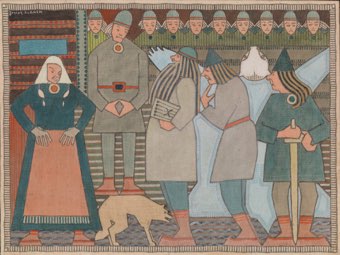
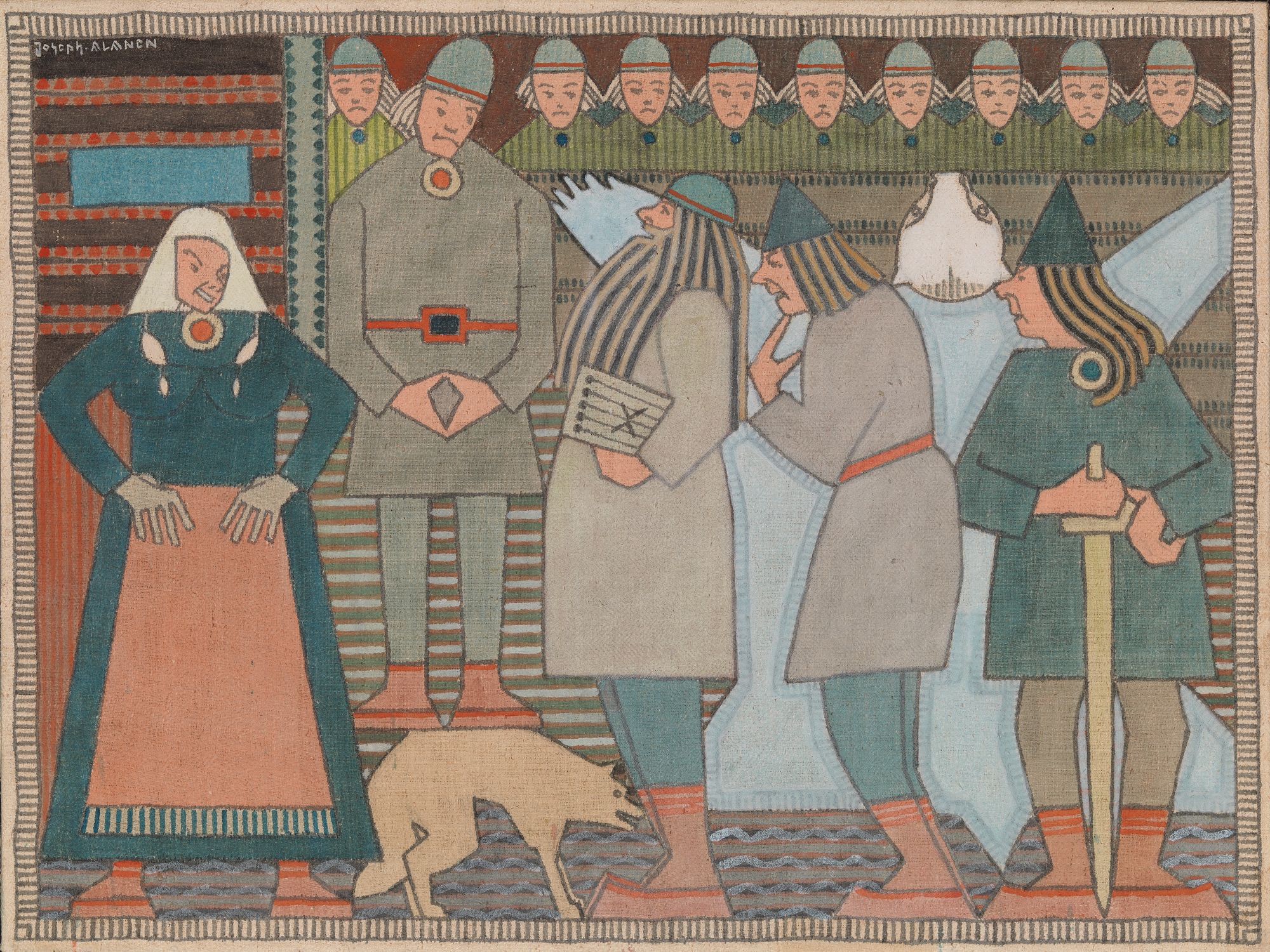
Väinämöinen, Ilmarinen and Lemminkäinen Arrive in Pohjola Canto 42 · Lines 1–58Väinämöisen, Ilmarisen ja Lemminkäisen tulo Pohjolaan (Väinämöinen, Ilmarinen and Lemminkäinen Arrive in Pohjola). Joseph Alanen, undated. Read the scene: The three heroes arrive in Pohjola, canto 42, lines 1–58 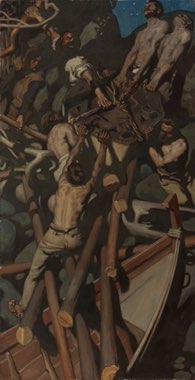
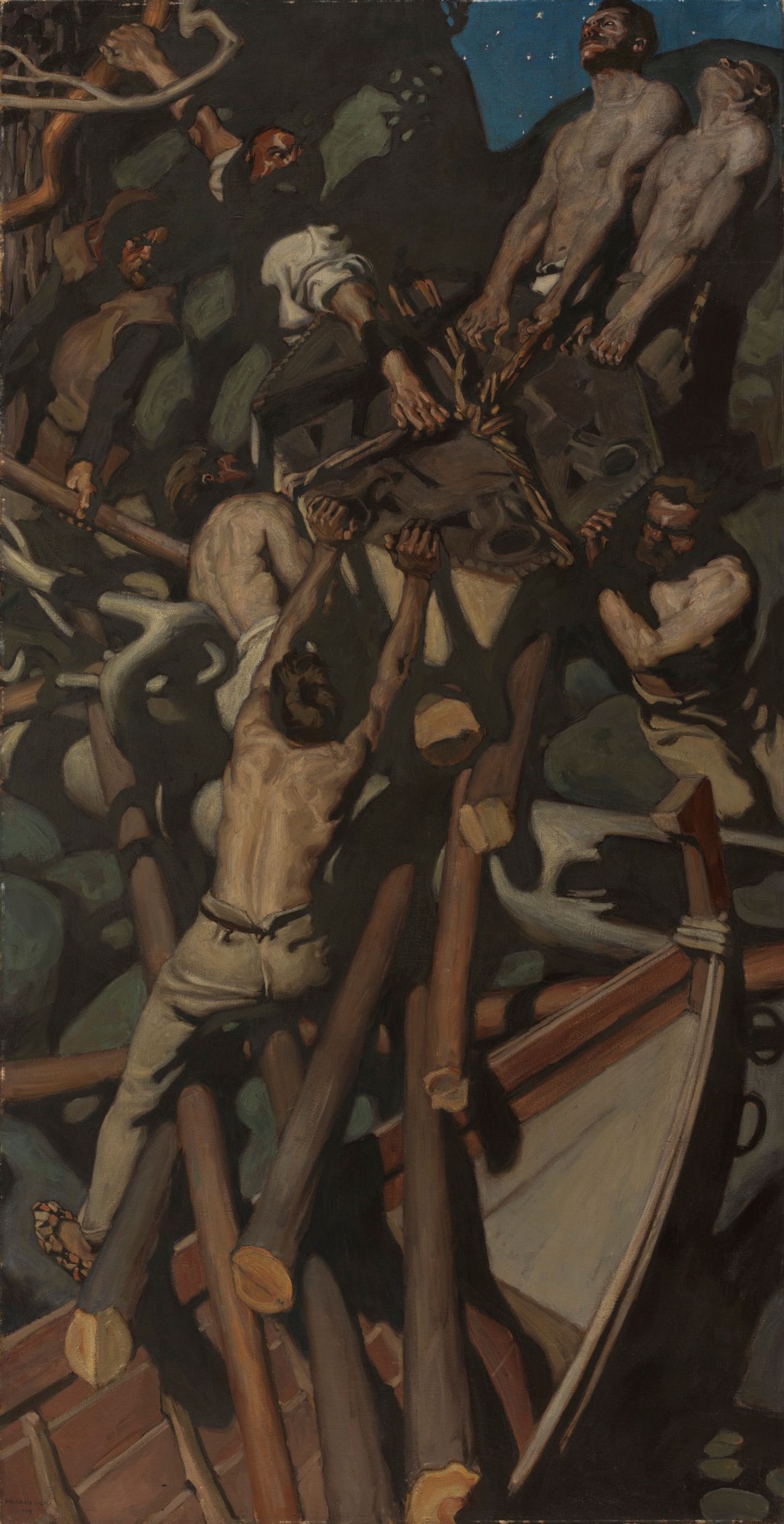
The Theft of the Sampo Canto 42 · Lines 65–164Sammon ryöstö (The Theft of the Sampo). Akseli Gallen-Kallela, 1905. Read the scene: The heroes take the Sampo out of the stone mountain, canto 42, lines 65–164 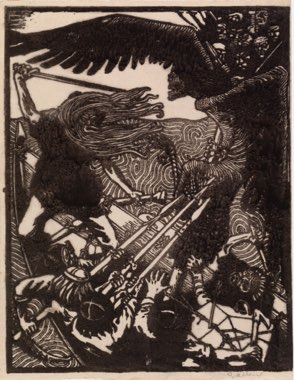
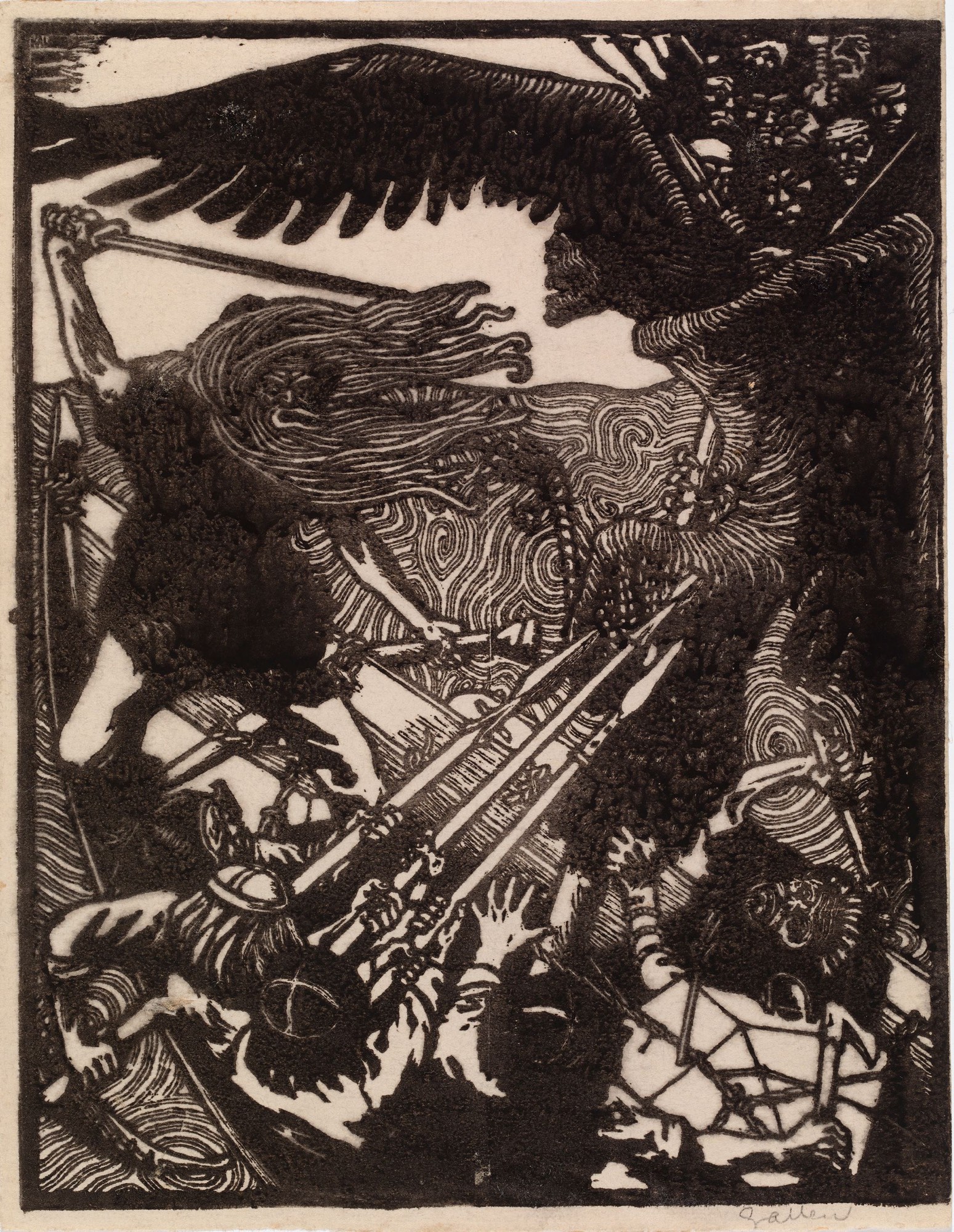
Defence of the Sampo Canto 43 · Lines 23–258Sammon puolustus (Defence of the Sampo). Akseli Gallen-Kallela, 1895. Read the scene: The mistress of Pohjola attacks the raiders of the Sampo at sea, canto 43, lines 23–258
Song types (SKVR and ERAB songs; JR records carry none)
Polvenhaava, Tulen synty, Kanteleen soitto, Kilpalaulanta, Tulen sanat, Laivaretki, Väinämöisen ammunta, Kanteleen synty, Maailmansyntyruno, Sammon ryöstö, Löylyn synty, Veneenveisto
The full list, with the number of songs, is under Counts.
The cantos where Väinämöinen appears
- Canto 1
Prelude. The Virgin of the Air descends into the sea, where she is fertilized by the winds and waves and becomes the Water-Mother. A teal builds its nest on her knee, and lays eggs. The eggs fall from the nest and break, but the fragments form the earth, sky, sun, moon and clouds. The Water-Mother creates capes, bays, sea-shores, and the depths and shallows of the ocean. Väinämöinen is born from the Water-Mother, and is tossed about by the waves for a long time until he reaches the shore.
- Canto 2
Väinämöinen lands on a treeless country and directs Sampsa Pellervoinen to sow trees. At first the oak will not grow, but after repeated sowings it springs up, overshadows the whole country, and hides the sun and moon. A little man rises from the sea, who fells the oak, and permits the sun and moon to shine again. Birds sing in the trees; herbs, flowers and berries grow on the ground; only the barley will not spring up. Väinämöinen finds some barleycorns in the sand on the shore, and fells the forest, leaving only a birch-tree as a resting-place for the birds. The eagle, grateful for this, strikes fire, and the felled trees are consumed. Väinämöinen sows the barley, prays to Ukko for its increase, and it grows and flourishes.
- Canto 3
Väinämöinen increases in wisdom and composes songs. Joukahainen sets out to contend with him in wisdom; but as he cannot overcome him, he challenges him to a duel, whereupon Väinämöinen grows angry, and sinks him in a swamp by his magic songs. Joukahainen, in great distress, finally offers his sister Aino in marriage to Väinämöinen, who accepts the offer and releases him. Joukahainen returns home discomfited, and relates his misfortunes to his mother. The mother rejoices at the prospect of such an alliance, but the daughter laments and weeps.
- Canto 4
Väinämöinen meets Aino in the wood and addresses her. Aino hurries home weeping, and informs her mother. Her mother forbids her to weep, and tells her to rejoice, and to adorn herself handsomely. Aino continues to weep, and declares that she will never take a very old man as her husband. She wanders sorrowfully into the wild woods, and reaches the banks of a strange unknown lake, where she goes to bathe, and is lost in the water. The animals commission the hare to carry the tidings of Aino's death to her home. Her mother weeps for her night and day.
- Canto 5
Väinämöinen fishes for Joukahainen's sister in the lake, and draws her into his boat in the form of a fish. He is about to cut her to pieces when she slips from his hand into the lake, and tells him who she is. Väinämöinen tries to persuade her to return to him, and then fishes for her, but in vain. He returns home disconsolate, and his dead mother advises him to woo the Maiden of Pohja.
- Canto 6
Joukahainen cherishes hatred against Väinämöinen and lies in wait for him on his journey to Pohjola. He sees him riding past and shoots at him, but only kills his horse. Väinämöinen falls into the water and is driven out to sea by a tempest, while Joukahainen rejoices, because he thinks he has at last overcome Väinämöinen.
- Canto 7
Väinämöinen swims for several days on the open sea. The eagle, grateful to him for having spared the birch-tree for him to rest on, when he was felling the trees takes Väinämöinen on his wings, and carries him to the borders of Pohjola, where the Mistress of Pohjola takes him to her abode, and receives him hospitably. Väinämöinen desires to return to his own country, and the Mistress of Pohjola permits him to depart, and promises him her daughter in marriage if he will forge the Sampo in Pohjola. Väinämöinen promises that when he returns home he will send the smith Ilmarinen to forge the Sampo, and the Mistress of Pohjola gives him a horse and a sledge to convey him home.
- Canto 8
On his journey Väinämöinen encounters the magnificently-clad Maiden of Pohja, and makes advances to her. The maiden at length consents to his wishes if he will make a boat from the splinters of her spindle, and move it into the water without touching it. Väinämöinen sets to work, but wounds his knee severely with his axe, and cannot stanch the flow of blood. He goes in search of some magic remedy and finds an old man who promises to stop the bleeding.
- Canto 9
Väinämöinen repeats to the old man the legend of the origin of iron. The old man reviles the iron and repeats spells for the stopping of blood, and the flow of blood is stayed. The old man directs his son to prepare a salve, and dresses and binds up the wound. Väinämöinen is cured, and thanks Jumala for his merciful assistance.
- Canto 10
Väinämöinen reaches home and urges Ilmarinen to depart to woo the Maiden of Pohja, because he would be able to forge a Sampo. Ilmarinen refuses to go to Pohjola, but Väinämöinen conveys him thither without his consent by a stratagem. Ilmarinen arrives in Pohjola, where he is very well received, and promises to forge a Sampo. He forges the Sampo, and the Mistress of Pohjola conceals it in the Rocky Mountain of Pohjola. Ilmarinen asks for the maiden as his reward, but she makes excuses, saying that she is not yet ready to leave home. Ilmarinen receives a boat, returns home, and informs Väinämöinen that he has forged the Sampo in Pohjola.
- Canto 16
Väinämöinen orders Sampsa Pellervoinen to seek for wood for boat-building. He makes a boat, but finds himself at a loss for want of three magic words. As he cannot otherwise obtain them, he goes to Tuonela hoping to procure them there. Väinämöinen finally escapes from Tuonela, and after his return warns others not to venture there, and describes what a terrible place it is and the horrible abodes in which men dwell there.
- Canto 17
Väinämöinen goes to obtain magic words from Antero Vipunen, and wakes him from his long sleep under the earth. Vipunen swallows Väinämöinen, and the latter begins to torture him violently in his stomach. Vipunen tries every means that he can think of to get rid of him by promises, spells, conjurations and exorcisms, but Väinämöinen declares that he will never depart till he has obtained from Vipunen the words which he requires to finish his boat. Vipunen sings all his wisdom to Väinämöinen, who then leaves his body, returns to his boat-building, and finishes his boat.
- Canto 18
Väinämöinen sets sail in his new boat to woo the Maiden of Pohja. Ilmarinen's sister sees him, calls to him from the shore, learns the object of his journey, and hastens to warn her brother that a rival has set forth to Pohjola to claim the bride. Ilmarinen makes ready, and rides on horseback to Pohjola along the shore. The Mistress of Pohjola sees the suitors approaching, and advises her daughter to choose Väinämöinen. But the daughter herself prefers Ilmarinen, the forger of the Sampo, and tells Väinämöinen, who is first to arrive, that she will not marry him.
- Canto 19
Ilmarinen arrives at the homestead of Pohjola, woos the daughter of the house, and perilous tasks are assigned to him. Aided by the advice of the Maiden of Pohja he succeeds in performing the tasks successfully. Firstly, he ploughs a field of serpent, secondly, he captures the Bear of Tuoni and the Wolf of Manala, and thirdly, he captures a large and terrible pike in the river of Tuonela. The Mistress of Pohjola promises and betroths her daughter to Ilmarinen. Väinämöinen returns from Pohjola in low spirits, and warns every one against going wooing in company with a younger man.
- Canto 20
An enormous ox is slaughtered in Pohjola. They brew ale and prepare a feast. They dispatch messengers to invite the heroes to the wedding, but Lemminkainen is expressly passed over.
- Canto 21
The bridegroom and his party are received at Pohjola. The guests are hospitably entertained with abundance of food and drink. Väinämöinen sings and praises the people of the house.
- Canto 25
The bride, the bridegroom and their company are received at the home of Ilmarinen. The company are hospitably entertained with food and drink: and Väinämöinen sings the praises of the host, the hostess, the inviter, the bridesmaid, and the other wedding-guests. On the way back Väinämöinen's sledge breaks down, but he repairs it, and drives home.
- Canto 36
Kullervo prepares for war and leaves home joyfully, for no one but his mother is sorry that he is going to his death. He comes to Untamola, lays waste the whole district, and burns the homestead. On returning home he finds his home deserted, and no living thing about the place but an old black dog, with which he goes into the forest to shoot game for food. While traversing the forest he arrives at the place where he met his sister, and ends his remorse by killing himself with his own sword.
- Canto 37
Ilmarinen weeps long for his dead wife and then forges himself a wife of gold and silver with great labour and trouble. At night he rests by the golden bride, but finds in the morning that the side which he has turned towards her is quite cold. He offers his golden bride to Väinämöinen, who declines to receive her, and advises him to forge more useful things, or to send her to other countries where people wish for gold.
- Canto 38
Ilmarinen goes to Pohjola to woo the younger sister of his first wife, but as he receives only insulting words in reply, he becomes angry, seizes the maiden, and starts on his homeward journey. On the way the maiden treats Ilmarinen with contempt, and provokes him till he changes her into a seagull. When Ilmarinen comes home, he relates to Väinämöinen how the inhabitants of Pohjola live free from care since they possessed the Sampo; and also tells him how badly his wooing has prospered.
- Canto 39
Väinämöinen persuades Ilmarinen to go with him to Pohjola to bring away the Sampo. Ilmarinen consents, and the heroes start off on their journey in a boat. Lemminkainen hails them from the shore, and on hearing where they are going, proposes to join them, and is accepted as a third comrade.
- Canto 40
The Sampo-raiders come to a waterfall, beneath which the boat is caught fast on the back of a great pike. The pike is killed, and the front part is taken into the boat, cooked, and eaten. Väinämöinen makes the jaws of the pike into a kantele, on which several of the party attempt to play, but without success.
- Canto 41
Väinämöinen plays on the kantele, and all living things, whether belonging to the air, earth, or water, hasten to the spot to listen. The hearts of all listeners are so affected by the music that tears fall from their eyes, and Väinämöinen's own eyes shed large drops which fall to the ground and trickle into the water, where they are changed into beautiful blue pearls.
- Canto 42
The heroes arrive at Pohjola, and Väinämöinen announces that he has come to take possession of the Sampo, either with good-will, or by force. The Mistress of Pohjola refuses to yield it either by consent or by compulsion, and calls together her people to oppose him. Väinämöinen takes the kantele, begins to play, and lulls to sleep all the people of Pohjola, and goes with his companions to search for the Sampo; they take it from the stone mountain and convey it to the boat. They sail homewards well satisfied, carrying the Sampo with them. On the third day the Mistress of Pohjola wakes from her sleep, and when she finds that the Sampo has been carried off, she prepares a thick fog, a strong wind, and other impediments, to oppose the robbers of the Sampo, which reach the vessel, and during the tempest Väinämöinen's kantele falls into the water.
- Canto 43
The Mistress of Pohjola equips a war-vessel and goes in pursuit of the robbers of the Sampo. When she overtakes them a fight ensues between the forces of Pohjola and Kalevala in which the latter conquer. Nevertheless the Mistress of Pohjola succeeds in dragging the Sampo from the boat into the lake, where it breaks to pieces. The larger portions sink in the lake, and form its riches, while the smaller pieces are thrown on shore by the waves, at which Väinämöinen is much pleased. The Mistress of Pohjola threatens to send all evil upon Kalevala, to which Väinämöinen pays no attention. The Mistress of Pohjola returns home in great distress, taking with her only a small fragment of the cover of the Sampo. Väinämöinen carefully collects the fragments of the Sampo on the shore, and plants them, hoping for continuous good fortune.
- Canto 44
Väinämöinen goes to seek for his kantele which was lost in the lake, but cannot find it. He makes himself a new kantele of birchwood, on which he plays, and delights every creature in the neighbourhood.
- Canto 45
The Mistress of Pohjola sends terrible diseases to Kalevala. Väinämöinen heals the people by powerful incantations and unguents.
- Canto 46
The Mistress of Pohjola sends a bear to destroy the herds of Kalevala. Väinämöinen kills the bear, and a great feast is held in Kalevala in honour of the occasion. Väinämöinen sings, plays on the kantele, and hopes that a time of great happiness and prosperity is coming to Kalevala.
- Canto 47
The moon and sun descend to listen to Väinämöinen's playing. The Mistress of Pohjola succeeds in capturing them, hides them in a mountain, and steals the fire from the homes of Kalevala. Ukko, the Supreme God, is surprised at the darkness in the sky, and kindles fire for a new moon and a new sun. The fire falls to the ground, and Väinämöinen and Ilmarinen go to search for it. The Virgin of the Air informs them that the fire has fallen into Lake Alue, and has been swallowed by a fish. Väinämöinen and Ilmarinen try to catch the fish with a net of bast, but without success.
- Canto 48
The heroes prepare a linen net, and at length capture the fish which has swallowed the fire. The fire is found in the fish's belly, but flashes up suddenly, and burns Ilmarinen's cheeks and hands severely. The fire rushes into the forest, burns over many countries, and spreads further and further, till at length it is captured and carried to the dark dwellings of Kalevala. Ilmarinen recovers from his burns.
- Canto 49
Ilmarinen forges a new moon and sun but cannot make them shine. Väinämöinen discovers by divination that the moon and sun are hidden in the mountain of Pohjola, goes to Pohjola and conquers the whole nation. He sees the moon and sun in the mountain, but cannot enter. He returns home to procure tools with which to break open the mountain. While Ilmarinen is forging them, the Mistress of Pohjola, fearing that it may go ill with her, releases the moon and sun. When Väinämöinen sees the moon and sun reappear in the sky, he salutes them, hoping that they will always go brightly on their course, and bring happiness to the country.
- Canto 50
The virgin Marjatta swallows a cranberry and brings forth a boy. The child disappears and is found after a long search in a swamp. He is taken to an old man to be baptized, but the latter will not baptize the fatherless child until after due consideration. Väinämöinen comes to inquire into the matter, and advises that the ill-omened boy should be put to death, but the child reproaches him for his unjust sentence. The old man baptizes the boy as King of Carelia, at which Väinämöinen is grievously offended and leaves the country, but first declares that he will again make a new Sampo and kantele, and light for the people. He sails away in a copper boat to a land between earth and heaven, but he leaves behind his kantele and his great songs as a parting gift to his people. Concluding verses.
Summaries: W. F. Kirby, 1907, from Lönnrot's summaries in the 1849 edition.
Counts
Songs naming Väinämöinen: 2,289.
By collection: SKVR 1,761; JR 527; ERAB, Finnish-language songs 1.
Regions, with the number of songs (a region counts every song from any of its places once): Viena 667, Laatokan Karjala (Raja-Karjala) 355, Pohjois-Karjala 283, Aunus 208, Kainuu 143, Etelä-Savo 90, Keski-Suomi 83, Pohjois-Savo 81, Pohjois-Pohjanmaa 80, Etelä-Karjala 60, Itä- ja Pohjois-Inkeri 57, Länsi-Inkeri 49, Peräpohjola 32, Keski-Inkeri 30, Etelä-Pohjanmaa 22, Häme 16, Satakunta 15, Metsäsuomalaisten alue 11, Varsinais-Suomi 4, Uusimaa 3, Harjumaa 1.
Places on the map, with the number of songs (a song given two places counts at both): Vuokkiniemi 317, Suistamo 165, Kontokki 125, Ilomantsi 113, Uhtua 112, Suojärvi 85, Kiimaisjärvi 70, Repola 60, Korpiselkä 47, Pistojärvi 42, Suomussalmi 42, Jyskyjärvi 32, Sotkamo 32, Kitee 31, Soikkola 31, Lempaala 29, Porajärvi 25, Viena 25, Kivijärvi 23, Kaprio 21, Nurmes 20, Sakkola 20, Etelä-Savo 19, Tulemajärvi 19, Impilahti 17, Narvusi 17, Kesälahti 16, Kittilä 15, Juva 14, Kaavi 14, Pohjois-Pohjanmaa 14, Viitasaari 14, Kainuu 13, Kestilä 13, Pielavesi 13, Pielisjärvi 13, Soanlahti 13, Rautalampi 12, Saarijärvi 12, Säämäjärvi 12, Kiestinki 11, Pieksämäki 11, Vuole 11, Hyrynsalmi 10, Iisalmi 10, Joroinen 10, Juuka 10, Rääkkylä 10, Salmi 10, Kiuruvesi 9, Muuruvesi 9, Tohmajärvi 9, Valtimo 9, Vieljärvi 9, Kärsämäki 8, Parikkala 8, Sortavala 8, Toksova 8, Kuhmo 7, Paltamo 7, Pohjois-Karjala 7, Pulkkila 7, Reisjärvi 7, Ilmajoki 6, Jaakkima 6, Kerimäki 6, Kiihtelysvaara 6, Kuusamo 6, Lappajärvi 6, Metsäpirtti 6, Pihtipudas 6, Pudasjärvi 6, Rautavaara 6, Säräisniemi 6, Karstula 5, Kemi 5, Kinnula 5, Kontiolahti 5, Piippola 5, Ristijärvi 5, Sonkajärvi 5, Suonenjoki 5, Tyrö 5, Uukuniemi 5, Etelä-Karjala 4, Haapajärvi 4, Hankasalmi 4, Kurkijoki 4, Lapinlahti 4, Liperi 4, Nilsiä 4, Paatene 4, Pyhäjärvi 4, Pyhäntä 4, Savitaipale 4, Savonranta 4, Taivalkoski 4, Tuupovaara 4, Varpaisjärvi 4, Hiitola 3, Karttula 3, Köyliö 3, Laukaa 3, Lemi 3, Maaninka 3, Moloskovitsa 3, Multia 3, Muonio 3, Mäntyharju 3, Pohjois-Savo 3, Pyhäjärvi Ol. 3, Ruskeala 3, Räisälä 3, Rääpyvä 3, Siilinjärvi 3, Tyrvää 3, Utajärvi 3, Östmark 3, Asikkala 2, Brandval 2, Eno 2, Grue Finnskog 2, Haukipudas 2, Joutsa 2, Jäppilä 2, Kangasniemi 2, Keltto 2, Kuhmoinen 2, Kurikka 2, Kuusjärvi 2, Kärkölä 2, Leppävirta 2, Miikkulainen 2, Munjärvi 2, Oulu 2, Paanajärvi 2, Puolanka 2, Puumala 2, Pyhäjärvi Vpl. 2, Rantasalmi 2, Rautu 2, Ristiina 2, Rovaniemi 2, Salo 2, Sodankylä 2, Turtola 2, Tuulos 2, Valkeasaari 2, Veteli 2, Vihanti 2, Vuolijoki 2, Alavieska 1, Aunus 1, Eräjärvi 1, Halikko 1, Harjavalta 1, Heinjoki 1, Huittinen 1, Isokyrö 1, Jämsä 1, Kajaani 1, Kangasala 1, Kattila 1, Kauhava 1, Keitele 1, Kemijärvi 1, Korpilahti 1, Kortesjärvi 1, Kuopio 1, Kuopio mlk 1, Kymi 1, Laatokan Karjala (Raja-Karjala) 1, Lapinjärvi 1, Lappee 1, Lekvattnet 1, Metsäsuomalaisten alue 1, Muolaa 1, Nivala 1, Orivesi 1, Oulainen 1, Oulanka 1, Padasjoki 1, Petroskoi 1, Polvijärvi 1, Pyhäjoki 1, Pyhäselkä 1, Rantsila 1, Riihimäki 1, Ruokolahti 1, Simo 1, Sortavala mlk 1, Sulkava 1, Suomenniemi 1, Säfsnäs 1, Sääminki 1, Södra Finnskoga 1, Tallinn 1, Tammela 1, Teisko 1, Tervo 1, Tuusniemi 1, Tuusula 1, Tyrnävä 1, Töysä 1, Uskela 1, Vanaja 1, Venjoki 1, Virtasalmi 1, Vitele 1, Vöyri 1, Ylihärmä 1, Ylitornio 1.
Songs whose record gives no place that can be put on the map: 8.
The ten places with the most songs account for 1,136 of the 2,281 songs that have a place on the map (50%).
SKVR and ERAB songs without a song type: 4 of 1,762 (0%).
Song types, with the number of songs: Polvenhaava 220, Tulen synty 214, Kanteleen soitto 207, Kilpalaulanta 204, Tulen sanat 199, Laivaretki 187, Väinämöisen ammunta 171, Kanteleen synty 169, Maailmansyntyruno 114, Sammon ryöstö 97, Löylyn synty 95, Veneenveisto 92, Löylyn luku 86, Sammon taonta 83, Kilpakosinta 74, Verensulku 74, Vipusen virsi 74, Purren itku 72, Raudan sanat 63, Raudan synty 62, Lemminkäisen virsi 58, Taivaan taonta 48, Vellamon neidon onginta 48, Kultaneito 46, Iro-neito 40, Hiidestä kosinta 39, Tuonelassa käynti 38, Kylvetyssanoja 29, Pistos 29, Vieraalle maalle joutunut 28, Kalevanpojan kosto 26, Pistoksen synty 26, Saaren neidot 26, Käärmeen sanat 25, Kyynelten vierintä 24, Käärmeen synty 24, Rutsa 22, Väinämöisen kielto 19, Ihmehevonen 17, Iso tammi 17, Viron orja ja isäntä 17, Avunpyyntö 16, Erilaisia parannusloitsuja 16, Vuoresta veden synty 16, Kalojen valituksia 15, Väinämöisen tuomio 15, Voiteen synty 14, Hääväki varataan 13, Iivana Kojosenpoika 13, Puun sanat 11, Venepuun etsintä 11, Vesi vanhin veljeksistä 11, Ilmanimmen kosinta 10, Kateita ja noitia vastaan 10, Kuoharin sanat 10, Riisi 10, Synnytys 10, Ihmetupa 9, Kalervo ja Untamo 9, Kehoitus laulamaan 9, Päivän päästö 9, Kiven vihat 8, Lemminkäisen surma 8, Luonnon nostatus 8, Nuotan synty 8, Puun synty 8, Riiden synty 8, Aukaisen sanaisen arkun 7, Ei ilo ilolle tunnu, ellei Väinämöinen laula 7, Laulajan alkusanoja 7, Miekan tai keihään kuvaus 7, Oluen uhkaus 7, Polin puulle pyörivälle 7, Sotaan lähtiessä 7, Ukkosen sanat 7, Hiiden hirven hiihdäntä 6, Iso härkä 6, Jouduin juottoon jumalan 6, Käärmeen pureman historiola 6, Lasta kylvetettäessä 6, Metsälle lähtiessä 6, Onkijan lukuja 6, Paise 6, Sämpsä Pellervoinen 6, Väinämöinen sotaan 6, Väinämöisen veljenpoika 6, Ylösnousemusvirsi 6, Hammastauti 5, Iske tulta Ilmarinen 5, Istumme ilokivelle 5, Kaukamoisen virsi 5, Marketan runo 5, Mereen silta yksiöisistä vesoista 5, Niukahdus 5, Oikein on otavat tehty 5, Syöttäkää, juottakaa, viekää suojaan vävyn hevonen 5, Tautien synty 5, Tulipalossa 5, Ilmarisen takominen 4, Jänön jälille, revon rekeen 4, Karhua vastaan 4, Karhun synty 4, Kerskaukset ja varaukset 4, Kipusanoja 4, Kultapyörätammi 4, Lapsen itkettäjä 4, Läävämadon synty 4, Läävämato 4, Mahtuuko vävy tupaan? 4, Marjavirsi 4, Nurmen neito 4, Parempi on omalla maalla ropehesta vettä juoda 4, Pilvilampi 4, Päänpesu porolla ja lipeällä 4, Sormin soutaminen 4, Sorsa soitti kanteletta 4, Suka mereen 4, Sutta vastaan 4, Ukkosen synty 4, Vesille venehen mieli, naisen miehelään 4, Väinämöisen matka Pohjolaan 4, Vävyn virsi 4, Ähky 4, Ampiaisen sanat 3, Kalastajan sanoja 3, Kalmasta tarttuu 3, Karkotussanoja 3, Laivassa surmattu veli 3, Lemmennostoloitsut 3, Mataleenan virsi 3, Niukahduksen historiola 3, Ohran kylvö 3, Omat on virret oppimani 3, Pelästys 3, Ruven synty 3, Suden synty 3, Tulesta tarttuu 3, Täss on vanha virrenseppä 3, Virpoi otti saunan selkäänsä 3, Voiteen luku 3, Ahdin ja Kyllikin runo 2, Aikainen herätys 2, Alahalla allin mieli 2, Ammuksen synty 2, Ammus 2, Ampiaisen lumous 2, Anna itkeä itikan 2, Annikaisen virsi 2, Ei loputen virttä lauleta 2, Ei ole miestä mennehestä 2, Eivät tässä laudat laula 2, Emo jätti kuin jänön pojan 2, Emäntäni - kun nälkäni näkisit 2, Erilaisia syntyjä 2, Hammastaudin synty 2, Hevosen synty 2, Hiiden sepän kahlinta 2, Hirttäytynyt neito 2, Ihmemaa 2, Ihmisen synty 2, Inkerin virsi 2, Isä jätti iljenelle 2, Jaakko Pontus 2, Joka puu puree, joka sammakko sanoo 2, Jumala on pesemättä puhtukainen 2, Jumalass on juoksun määrä, eikä miehen miehuessa 2, Kaatumatauti 2, Kanto meressä 2, Karhun metsästys 2, Karhunpeijaiset 2, Katriinan poltto 2, Kiskoin kivestä tuohta 2, Kiven synty 2, Koskelta kosinta 2, Kuolon sanomat 2, Käärmetuoppi 2, Lapsen päästäminen kiroista 2, Laula, laula, kieli keito 2, Laulajan väki väsyy 2, Laulan laulajat mokomat 2, Lauri Lappalainen 2, Mitä istut isännän poika 2, Myyty neito 2, Nimettömät taudit 2, Näin ennen eukko, isä lauloi 2, Oli meitä ennen paljon 2, Pahasilmä 2, Painajainen 2, Pakkasen sanat 2, Rikkaan raha kuluu, köyhän raiskan pää menee 2, Runoreki 2, Rutto 2, Saunanhakuvirsi 2, Tietäjän apuri 2, Tulehenko teen tupani 2, Tunsit tulla, tunne olla 2, Vesitiellä viipynyt 2, Virret vilussa - pahassa paikassa 2, Virsikerä 2, Vuohella sotaan 2, Väärin teki Väinämöinen 2, Yöjalassa ollessa 2, Ähkyn synty 2, Älä lapsia lakaise, nosta lapset laavitsalle 2, Ammus eläimessä 1, Anna rullan ruikutella 1, Anteruksen runo 1, Ei ole tulusta tulta ottaa 1, Ei sula syän suruinen 1, Ei tiedä kotoiset vaimot, missä miehet mellakoivat 1, Eipä tiedä yksikänä 1, Elä, lapsi, paljon laula 1, Eläimet sanansaattajina 1, Emo ei saanut laululla rahoja 1, Emo neuvoi poikiansa - sodassa 1, En meroa kiitä, nielee miehet 1, En mä elä elotta, asu ilman ammatitta 1, En ole laulajan lajia 1, Ennen metsä puita puuttuu 1, Ennen naidun naisen tappo 1, Haikko suulleni tuloo 1, Haittan' on hako vesillä, köyhät eellä rikkahalla 1, Harvon syötti harva verkko, vaan sillon suurilla kaloilla 1, Haukan synty 1, Hotari hopeaseppä 1, Huolihevonen 1, Hyle 1, Hylkeen synty 1, Hyvä on hylkeen meressä 1, Hyvä on lapsen lassa olla, hyvän vanhemman varassa 1, Hämeen ihmeet 1, Illalla hyvä laulaa 1, Iski tulta Ilmarinta 1, Iso hauki 1, Ison kotona ja toiselassa 1, Isä oron osti naidakseni 1, Isälle ja vieraalle jauhaminen, soutaminen 1, Itse manalle mennyt 1, Jos mun tuttuni tulisi 1, Jouduin nuorien pariin 1, Juomariksi joutunut 1, Juomarille joutunut 1, Kaikki sukuni kuoli kunnialla - minä ouoin surmin 1, Karhun vihat 1, Karhunkalloriitti 1, Karjaa laitumelle laskettaessa 1, Karjan menestymiseksi 1, Karjan suojeleminen ja päästäminen kateista 1, Kateen sanat 1, Keihään synty 1, Kettusen runo 1, Kielitaitoinen laulaja 1, Kierosilmäisyys ja päätauti 1, Kirot 1, Kitumasta päästetään 1, Koiran synty 1, Kokkovirsi 1, Kolkan käännän 1, Kommilta kosinta 1, Konnusta kosinta 1, Kosiin mennessä 1, Koskea laskiessa 1, Kuin en nainut naiskulua 1, Kukku siulla, kukku miulla 1, Kukkua käki lupasi, minä laulaa 1, Kullasta saari 1, Kumma kuulijoille 1, Kun kuolisin kotiin, en korpeen 1, Kyllä tuo ommella osaa, kankaita kutoa 1, Käy ulkona usein kuuta katsomassa 1, Käärmeen pidätys ja lumous 1, Laatikaamme piilopirtti 1, Lapista, Turjan maalta, lintu, yksi siipi vettä viisti 1, Laulaisin omilla mailla 1, Laulajan kerskauksia 1, Laulajan lopetussanoja 1, Laulajan palkka 1, Laulan laiha poika 1, Laulanta runolla työnä - kukunta käellä 1, Liuvuin surman suun eteen 1, Lunastettava neito 1, Lupa koiran luuta purra, hirven hankia hypätä 1, Luulin lumpehen pitävän 1, Läksin piennä paimeneen 1, Lääväaskareet 1, Löi kahta kämmentänsä 1, Löysin kukkaron kujalta 1, Maasta tarttuu 1, Maito-onnea poikineelle lehmälle 1, Matkalle lähtiessä 1, Mene myötä, myyty neiti 1, Meren kosijat 1, Meren neito, metsän sulho 1, Meri syötti, meri juotti 1, Metsästä tarttuu 1, Metsästäjän varautuminen kateita vastaan 1, Mie vaan yksin yötä vietän 1, Miehen kolme pahaa 1, Miehentappajaneito 1, Mielenvikaisuus 1, Mies oli ennen miun isäni 1, Miksi on utuinen ilma 1, Mikä lie minusta nähty, kun ei naitu naapurihin 1, Mikä yksi? 1, Minä laulan uutta virttä 1, Minä menin metsään 1, Minä olen noidan nuorin poika 1, Minäpä luotan Luojahani 1, Mistä tiesi teukamoinen 1, Miten ollen, kuin elänen 1, Mitä tehä miun poloisen tämän suuren huolen kanssa 1, Moni mies, moni hevonen sortuupi sotikeolle 1, Moni moittii laulujamme 1, Morsianta neuvotaan liikkumaan ripeästi 1, Neidon kankaankudonta 1, Neuvo neittä nelinurkkaisessa 1, Neuvo neittä neljä vuotta 1, Noidille Viroon 1, Nuotalla 1, Olin kuin orihevonen 1, Oljamissa käynti 1, Oman ja/tai vieraan emon aamuherätys 1, On maata muuallakin 1, Onko Otava, tähdet ja taivas oikein osattu 1, Oravan metsästys 1, Osasi emo omenan tehdä 1, Ota vitsa viitan alta 1, Painajaisen synty 1, Pakkasen synty 1, Pentin linna 1, Pese perheen silmät 1, Petolinnun pureman parantaminen karjasta 1, Pimeä isoton pirtti 1, Pirtin siivous ja astiain pesu 1, Poikinut lehmä tai vasikka varataan 1, Puun vihojen varalta 1, Päästäisen sanat 1, Päästäisen synty 1, Raani 1, Raanin synty 1, Raudan lumous 1, Rikkeet 1, Rikkeistä päästetään 1, Rikoilla kuuntelija 1, Rullille kostetaan 1, Rullin pilaama lehmä parannetaan 1, Ryyhtymätauti 1, Saaresta kosinta 1, Sammakon jälki 1, Sammakon synty 1, Sanottiin Matin/Marin kanssa maanneeni 1, Satoi ukko uutta lunta 1, Saunan synty 1, Saunapakana 1, Sian synty 1, Sikoja salvettaessa 1, Silmäpasko 1, Silmätauti 1, Sisiliskon sanat 1, Sisiliskon synty 1, Soisit suohon sortuvani 1, Sota Narvan tienoilla 1, Sotasanomat 1, Souda laiva Suomeen 1, Suden purema 1, Suotta soimat nostettiin 1, Suu suruinen laulajalla 1, Syntymistään sureva 1, Syrjin synnyin, kasvoin 1, Syyttä laulaminen - synti 1, Taivaanvalojen kosinta 1, Tartunta 1, Tautien ja vammojen historioloita 1, Tautisuolojen valmistaminen 1, Telkkä poikia tekevi 1, Tervan synty 1, Tervanpoltto 1, Tiedänhän mie tilkun maata 1, Tule tehdyille teloille 1, Tule tuulena tupaan 1, Tule uni ulkoa 1, Tuli ukko Turjan maalta 1, Tulta käsiteltäessä 1, Tunnen tuulet, tunnen tyynet 1, Tuntuu tuomi muista puista, vävy muista vierahista 1, Tuokaa tulta tuohisella 1, Tuuleinen 1, Tuulen nosto 1, Tuuliaisen synty 1, Tuuti lasta turvakseni 1, Tähän istun, täss on lämmin, tähän muori muonan tuopi 1, Ulkoa runoja kuulin 1, Vainajan kummitteleminen estetään 1, Valjasti iso tulisen ruunan 1, Valtuutus 1, Varjele, vakaini Luoja 1, Vastasyntynyt 1, Vatsatauti 1, Veden hakeminen 1, Veden synty 1, Veri tippui vempeleestä 1, Viel on virret laulamatta 1, Vieläk laulan, vain on kyllä 1, Vilutaudin synty 1, Vilutauti 1, Virret läpi päästä lähtekööt 1, Vitun synty 1, Vitun vihat 1, Voiteen valmistus 1, Vuotit viikon, vuota vielä 1, Väinämöinen ajaa reessä 1, Väinämöinen jokehen 1, Väinämöinen kysyy 1, Väinämöinen takoo aseita 1, Väinämöinen veistää tulivenettä 1, Väinämöisen ja Jouhkavaisen kutsuminen 1, Väinämöisen lapset orjiksi 1, Väinämöisen rautakengät 1, Väinämöisen syntymä 1, Väinämöisen vertaukset 1, Väinäsen emännän kirnu 1, Äidin vaivojen palkinto 1, Älkää viekö vehkasuolle 1.
Spellings of the name, with the number of songs: väinämöinen 1,030, väinämöisen 901, väinämöini 290, väinämöistä 205, väinämöine 200, väinön 160, väinö 72, wäinämöinen 70, väinämön 64, wäinämöisen 53, väinämöin 46, väinämöizen 37, väinämö 26, väinämöni 24, väinämöiselle 18, väinäm 17, väinämöisellä 15, väinämösen 14, väinämöne 13, väinemöinen 10, väinöm 10, vainämöinen 9, väinämölle 8, väinämöllä 8, väinän 8, väinöi 8, vänämöne 8, väinämöise 7, väinösen 7, väinämöstä 6, väinämözen 6, väinöin 6, wäinämöistä 6, väenämöenen 5, väinämoinen 5, väinämöinji 5, väinämöisell 5, väinämöizem 5, vainämöisen 4, väinämönen 4, väinäsen 4, väinöltä 4, vänämöinen 4, vänämöni 4, väsmäröllä 4, wäinön 4, väenämöesen 3, väilämöine 3, väilämöisen 3, väinamöine 3, väinamöinen 3, väinämöi 3, väinämöille 3, väinämöisev 3, väinämöltä 3, väinämömen 3, väinämöönen 3, väinämööni 3, väinöjä 3, väinömöistä 3, viänämöisen 2, väenämöenev 2, väenämöesev 2, väinamöisen 2, väinimöisen 2, väinämoine 2, väinämoisen 2, väinämyt 2, väinämyöni 2, väinämöillä 2, väinämöinje 2, väinämöiseltä 2, väinämöisten 2, väinämöizellä 2, väinämöönji 2, väinöbä 2, väinöhö 2, väinöhön 2, väinöiltä 2, väinölle 2, väinöllä 2, väinössä 2, väinöukko 2, väjnämöjnen 2, vänämöisen 2, vänämösen 2, väänämöinen 2, wäinämoisen 2, wäinämöiſen 2, wäinämön 2, wäinämöönen 2, wäinöi 2, vainamoinen 1, vainamoises 1, vainamoistä 1, vainamöinen 1, vainamöisen 1, vainön 1, vajnamojnen 1, veännälmöinen 1, viänälmöine 1, väenämöene 1, väenämöener 1, väenämöese 1, väenämöesestä 1, väenämöineʼ 1, väilämöene 1, väilämöin 1, väilämöinen 1, väilämöinje 1, väilämöistä 1, väinamoinen 1, väinemyöine 1, väinemyöni 1, väinemyösen 1, väinemöini 1, väinemöiselle 1, väinimöine 1, väinimöltä 1, väinmöini 1, väinähän 1, väinäinöinen 1, väinäinömi 1, väinälle 1, väinälmöine 1, väinälmöini 1, väinämeehen 1, väinämeisen 1, väinämoini 1, väinämoistä 1, väinämoizlä 1, väinämolle 1, väinämystä 1, väinämyti 1, väinämyttä 1, väinämyzis 1, väinämyö 1, väinämyöli 1, väinämyösen 1, väinämäine 1, väinämäisen 1, väinämäisty 1, väinämäizen 1, väinämäizes 1, väinämäntä 1, väinämäzel 1, väinämää 1, väinämöh 1, väinämöihen 1, väinämöijsen 1, väinämöilen 1, väinämöill 1, väinämöinenp 1, väinämöinne 1, väinämöiseen 1, väinämöiselläkin 1, väinämöisem 1, väinämöiseni 1, väinämöiset 1, väinämöist 1, väinämöistenni 1, väinämöisty 1, väinämöitten 1, väinämöitä 1, väinämöize 1, väinämöizeldä 1, väinämöl 1, väinämöldä 1, väinämöm 1, väinämöme 1, väinämöseen 1, väinämösell 1, väinämösellä 1, väinämöseltä 1, väinämöset 1, väinämöösen 1, väinänöistä 1, väinäröin 1, väinättären 1, väinäväin 1, väinöherra 1, väinöille 1, väinöiltän 1, väinöistä 1, väinöldä 1, väinömäistä 1, väinömöine 1, väinömöizen 1, väinöne 1, väinöni 1, väinöseini 1, väinösiss 1, väinösissä 1, väinöstä 1, väinöväin 1, väinözen 1, väinöä 1, väismäröine 1, väismäröllä 1, väismäröni 1, väismörölle 1, väjnämöinen 1, väjnämöini 1, väjnämöjsen 1, vännämönen 1, vänämosell 1, vänämöin 1, vänämösellä 1, vänämösillä 1, vänämöty 1, väsmarolla 1, väsmeröllä 1, väsmäröll 1, väsmärölle 1, väsmäröltä 1, väänimäinen 1, väänämöisen 1, wainemoisen 1, wainämöisen 1, wainämöistä 1, wäinamoinen 1, wäinamöinen 1, wäinamöisen 1, wäinemöne 1, wäinämoinen 1, wäinämö 1, wäinämöiselle 1, wäinämöjsen 1, wäinämöltä 1, wäinämöni 1, wäinämösell 1, wäinän 1, wäinö 1, wäinöin 1.
Not counted: texts an editor reworked or put together, lines quoted in early scholars' books and papers, texts from early anthologies, poems the archive's editors doubted were folk poetry, composed poems, and texts learned from the Kalevala or other print: JR 01680, JR 02316, JR 02430, JR 02471, JR 02482, JR 02535, JR 02556, JR 03086, JR 03361, JR 03371, JR 03960, JR 04146, JR 06003, JR 07158, JR 17623, JR 19165, JR 21812, JR 24156, JR 25021, JR 25032, JR 25259, JR 25956, JR 27750, JR 28268, JR 29387, JR 29688, JR 30733, JR 31655, JR 33566, JR 36945, JR 38533, JR 39441, JR 39443, JR 39730, JR 44430, JR 45641, JR 48206, JR 48422, JR 53545, JR 60518, JR 66679, JR 66685, JR 66699, JR 66700, JR 66701, JR 66702, JR 68436, JR 70883, JR 70884, JR 70933, JR 75843, JR 78522, JR 80696, JR 84543, JR 84604, JR 85111, JR 85310, JR 85317, JR 85366, JR 85401, JR 85466, JR 85474, JR 85482, JR 85499, JR 85509, JR 85582, SKVR I1 261 a), SKVR I1 354 a), SKVR I1 597 a), SKVR I2 1057, SKVR IX4 1211, SKVR V3 liite 6, SKVR VI1 118, SKVR VI1 74, SKVR VI1 76, SKVR VI2 liite II 0, SKVR VI2 liite III 1, SKVR VI2 liite III 10, SKVR VI2 liite III 2, SKVR VII1 148 a, SKVR VII1 148, SKVR VII1 167, SKVR VII1 192, SKVR VII1 197, SKVR VII1 202, SKVR VII1 297, SKVR VII1 314, SKVR VII1 344, SKVR VII1 367, SKVR VII1 698, SKVR VII1 699, SKVR VII2 1493, SKVR VII2 1494, SKVR VII2 1495, SKVR VII2 1506, SKVR VII2 1646, SKVR VII5 Metsäs. 10, SKVR VII5 loitsut 4380, SKVR XII1 1, SKVR XII1 15, SKVR XII1 4057, SKVR XII1 4071, SKVR XII1 4488, SKVR XII1 4492, SKVR XII1 4504, SKVR XII1 4650, SKVR XII1 74 α, SKVR XII1 79, SKVR XII1 80, SKVR XII1 92, SKVR XII2 5239, SKVR XII2 5259, SKVR XII2 5304, SKVR XII2 5371, SKVR XII2 5998, SKVR XII2 6114, SKVR XII2 6345, SKVR XII2 6659, SKVR XII2 6660, SKVR XII2 7917, SKVR XII2 7918, SKVR XII2 8730, SKVR XIII1 225, SKVR XV 211, SKVR XV 239, SKVR XV 248, SKVR XV 250, SKVR XV 278, SKVR XV 281, SKVR XV 306, SKVR XV 316, SKVR XV 370, SKVR XV 61, SKVR XV 63, SKVR XV 64, SKVR XV 65, SKVR XV 66, SKVR XV 67, SKVR XV 70, SKVR XV 71.
Not counted a second time: 435 texts that copy a record held elsewhere in the collections (fair copies, copies among another collector's papers, excerpts printed separately).
About this page
A song counts on this page when it names Väinämöinen, in any spelling. A song counts once, however often the name occurs in it. The numbers say how many songs name the figure, not how many songs are about it.
The songs are the folk songs in RunoVerse from the SKVR and JR collections of the Finnish Literature Society and from the Estonian Folklore Archives (ERAB). Literary texts are left out: Lönnrot's Kalevala and its earlier versions, the Kanteletar and the other works of the KR corpus. So are songs that the archive files as learned from the Kalevala, and texts that turned out on reading to be an editor's reworking or compilation, lines quoted in early scholars' books and papers, texts from early anthologies, poems the archive's editors doubted were folk poetry, composed poems or texts learned from print, or to follow the printed Kalevala line by line; they are listed under Counts. An early print that is the only surviving record of a song is counted, and so are songs in which the archive's editors saw only some influence of print. When the collections hold one record twice, as a fair copy, as a copy among another collector's papers or as an excerpt printed separately, it counts once.
Each spelling of the name was sorted. Spellings that can only be the name count as they stand. Spellings that are also ordinary words or other names (aino 'only', for instance, or Ahti, also the name of a water god) were decided line by line, each line read in its song. The sorting and the line decisions were made by the AI model Claude Opus 5.5.
The places are those the archive records give: usually the place where the song was written down, for some songs the singer's home parish. A dashed circle marks a region named without a more exact place. A song given two places counts at both.
The cantos are those of Lönnrot's Kalevala of 1849 in which the figure is named. Under each canto is W. F. Kirby's summary of 1907.